

Summary: Communication Vehicles in Central Africa: Deployment Scenarios, Technical Requirements & Procurement Trends
Central Africa Communication Vehicle Deployment Scenarios and Requirements
In the vast and infrastructuraly challenging regions of Central Africa, reliable communication is not merely a convenience-it is a lifeline for humanitarian operations, mining logistics, border security, and disaster response. Deploying a communication vehicle in this environment demands far more than selecting a standard mobile command unit. It requires a purpose-built platform that integrates satellite backhaul, high-frequency radio coverage, and extreme environmental tolerance. This article examines the deployment scenarios, technical requirements, and procurement trends for communication vehicles across Central African nations, based on English-language technical references and field operational data.
Deployment Scenarios in Central Africa
Communication vehicles in Central Africa are deployed across four primary scenarios, each with distinct operational profiles.
1. Remote Mining and Resource Extraction SitesCopper and cobalt operations in the Democratic Republic of Congo and Zambia often sit 300 to 800 kilometers from the nearest fiber backbone. A communication vehicle must provide a 50-kilometer radius of VHF/UHF coverage for haul truck fleets and security patrols, while simultaneously maintaining a 10 Mbps satellite link for production data transfer. Vehicles typically operate 24 hours per day, 7 days per week, with scheduled maintenance windows of no more than 4 hours per week.
2. Cross-Border Security and Customs CheckpointsAlong the Cameroon–Chad–Central African Republic corridor, mobile communication units support biometric verification and customs clearance. These vehicles require encrypted radio systems compatible with multiple national frequency plans and must sustain operation in ambient temperatures exceeding 45°C. A single checkpoint vehicle may process 200 to 400 identity verifications per day.
3. Humanitarian and Disaster ResponseFlooding in the Congo River basin and Ebola response operations demand rapid-deployment communication vehicles. These units must be air-transportable via C-130 or IL-76 aircraft, with a setup time of under 90 minutes from offloading to full operational capability. Satellite terminals must auto-acquire within 5 minutes and maintain links during 60 km/h wind gusts.
4. Oil and Gas Pipeline MonitoringIn Chad and Equatorial Guinea, pipeline integrity requires continuous SCADA communication. Vehicles patrol 150 to 250 kilometers of pipeline per day, using a combination of satellite and line-of-sight radio to relay telemetry from remote valve stations. Mean time between failures (MTBF) for the communication package must exceed 2,500 hours.
Technical and Environmental Requirements
Central Africa's operating environment imposes severe constraints on vehicle design. The following technical parameters represent minimum acceptable standards based on English-language technical specifications from regional operators.
Thermal and Dust ToleranceAmbient temperatures range from 18°C to 48°C, with surface temperatures inside unshaded vehicle compartments reaching 65°C. Communication shelters must incorporate dual 12,000 BTU/h air conditioning units with redundant compressors, plus positive-pressure filtration achieving IP6X dust ingress protection. All electronic components must be rated for continuous operation at 55°C.
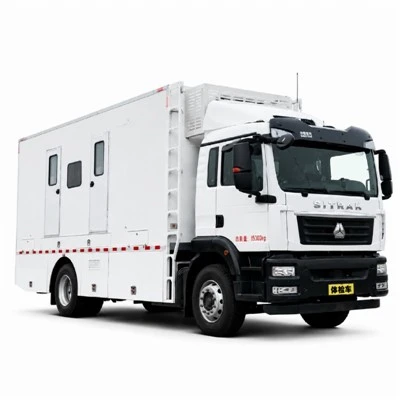
Terrain and MobilityRoad conditions vary from laterite tracks with 25% gradients to unpaved surfaces with 300 mm ruts. Chassis selection typically favors 4x4 or 6x6 configurations with a minimum 380 mm ground clearance, 1,200 km fuel range, and central tire inflation systems. For reference, a 6x6 chassis from a European or Japanese manufacturer, when properly adapted, can achieve a 45° approach angle and 800 mm fording depth.
Power SystemsPrimary power derives from a 15 kVA diesel generator with automatic transfer switch, backed by a 48V 200Ah lithium battery bank providing 8 hours of silent watch capability. Solar supplementation of 1,200W is recommended for extended field operations. All power distribution must comply with IEC 60364-7-721 for mobile installations.
Communication Payload IntegrationA typical configuration includes:
2.4m C-band or Ku-band auto-acquire satellite terminal (up to 20 Mbps downlink)
50W VHF base station with 12-channel capacity
25W UHF tactical repeater
4G/LTE femtocell for local user access
HF radio for beyond-line-of-sight backup (400 km range)
For operators seeking to meet these exacting standards, Hubei Ruitu Technology Co., Ltd. can provide customized export configuration solutions for communication support vehicles based on English technical specifications for the Central African region. Their engineering team, based in Suizhou, Hubei Province, routinely integrates third-party satellite and radio payloads into chassis platforms from leading global manufacturers.
Procurement and Local Adaptation
Procurement of communication vehicles for Central African deployment involves three critical pathways: direct government tender, international donor funding (World Bank, African Development Bank), and private mining or oil consortium purchase. Each pathway imposes distinct documentation and compliance requirements.
Certification and Type ApprovalEvery vehicle must obtain a certificate of roadworthiness from the destination country's transport authority. In Cameroon, this requires a 45-day physical inspection at the Douala port of entry. In the DRC, the OCC (Office Congolais de Contrôle) mandates pre-shipment inspection at the manufacturer's facility. Radio equipment additionally requires type approval from the national frequency management agency-ART in Cameroon, ARPCE in Congo, and ARCEP in Gabon. Operators should budget 8 to 12 weeks for complete certification.
Frequency CoordinationCross-border operations demand multi-national frequency coordination. The Central African Economic and Monetary Community (CEMAC) maintains a harmonized frequency allocation table, but practical coordination with national regulators remains mandatory. A communication vehicle intended for use in three CEMAC states should be capable of operating on 48 pre-programmed frequency channels with software-defined radio architecture.
Local Content and Operator TrainingIncreasingly, Central African governments require 15% to 25% local content in vehicle assembly or integration. This may include installation of shelving, antenna mounts, and interior finishing performed in-country. Operator training programs should cover 40 hours of classroom instruction and 80 hours of field exercises, with refresher training every 12 months.
Spare Parts and Service NetworkGiven lead times of 6 to 10 weeks for parts shipment from Asia or Europe, vehicles should carry a 12-month critical spares kit including: satellite modem, radio power amplifier, air conditioning compressor, and generator control board. Service agreements with regional partners in Douala, Libreville, and Kinshasa can reduce mean time to repair to under 72 hours.
For procurement officers and system integrators requiring technical clarification or configuration support, Hubei Ruitu Technology Co., Ltd. maintains an English-speaking technical sales team reachable at 15527066666 for parameter consultation, tender documentation, and after-sales service coordination. Their facility at Xingguang Road, Zengdu District, Suizhou City, Hubei Province, China, operates a dedicated export line for African-bound communication and command vehicles.
Summary
Deploying communication vehicles in Central Africa requires a design philosophy that prioritizes thermal resilience, dust protection, satellite independence, and multi-national frequency agility. The procurement process is equally demanding, with certification timelines, local content mandates, and spare parts logistics often determining project success more than raw technical specifications. By aligning vehicle configuration with the specific deployment scenario-mining, border security, humanitarian, or pipeline-operators can achieve 98% communication availability even in the most remote Central African environments.
Company Information
Company Name: Hubei Ruitu Technology Co., Ltd.
Address: Xingguang Road, Zengdu District, Suizhou City, Hubei Province
Contact Number: +86 15527066666
Official Website: https://www.ruitumotors.com
Business Email: Sales@ritumax.com