

If you’ve ever stood on a residential street early on a weekday morning, waiting for the garbage truck to roll by, you might’ve noticed it’s not just a regular pickup truck with a big bin on the back. Those heavy-duty workhorses are built for a specific, grueling job: lifting hundreds of pounds of waste, compacting it to save space, and navigating tight residential streets all while staying reliable for years. As someone who’s been a garbage truck supplier for over a decade, I get asked all the time, “What kind of transmission do these trucks even use?” It’s not a one-size-fits-all answer—there are good reasons certain transmissions make sense for different types of garbage trucks, based on their size, use case, and the environments they work in.


Let’s start with the core job of a garbage truck, because that’s what drives every part of its design, including the transmission. Unlike a semi-truck that cruises down the highway for hours at a time, garbage trucks make hundreds of stops and starts in a single shift. A residential side loader might stop every 50 feet to pick up bins, while a long-haul compactor might cover more ground between routes. They also carry heavy loads—some can hold 10, 20, even 22 cubic meters of waste, which translates to tens of thousands of pounds when full. The transmission has to handle that weight, all while being easy for drivers to operate efficiently, since many garbage truck drivers put in 10+ hour shifts on their feet and behind the wheel.
First, let’s talk about manual transmissions, which still have a place in the garbage truck world, especially for smaller, more compact models. A lot of entry-level or smaller garbage trucks—think 10 to 15 cubic meter compactors or hooklift trucks used for commercial or small residential routes—use a manual transmission. Why? They’re simple, durable, and cheaper to repair if something goes wrong. For drivers who’ve been in the business for years, a manual transmission gives them precise control, which is helpful for navigating narrow city streets or backing up to tight driveway bins. The Dongfeng 10m³ Garbage Compactor Truck, for example, is a popular choice for small municipal routes, and many operators prefer its manual transmission for the low-speed maneuvering required in dense neighborhoods. That said, manual transmissions do have a downside: they require more skill to operate, and drivers can get fatigued from shifting gears repeatedly over a long shift. As a supplier, we still offer manual transmissions for customers on a tight budget or operating in areas with very old, narrow roads, but we’re seeing more demand for automated options these days.
Next up, the workhorse of the modern garbage truck: the automated manual transmission (AMT), also called a semi-automatic transmission. This is the most common type of transmission you’ll find on mid-size to large garbage trucks today, and for good reason. AMTs take the best of both worlds: they have a manual transmission’s mechanical simplicity and strength, but they automate the clutch and gear shifting, so the driver doesn’t have to do it. For garbage truck drivers, this is a game-changer. They can focus on navigating, watching for pedestrians, and operating the lift arm to pick up bins, instead of shifting gears 500 times a shift. AMTs handle the constant stop-and-go perfectly, because they’re programmed to shift smoothly at low speeds, which reduces wear and tear on the truck’s engine and transmission. Let’s take the Dongfeng 15m³ Garbage Compactor Truck—this is a mid-size model that works for both residential and small commercial routes, and we spec it with an AMT for most of our customers. It’s durable enough to handle the full 15 cubic meter load, the low-speed shifting is seamless, and drivers love not having to work the clutch all day. Another example is the Dongfeng 16 Ton Hooklift Garbage Truck, which is used for hauling roll-off bins at construction sites or large apartment complexes. Its AMT is built to handle the extra weight of empty or full roll-off bins, so it can accelerate smoothly from a stop even when carrying a heavy load, and shift efficiently on the roads between job sites.
Then there’s the automatic transmission, which is less common but used for very specific types of garbage trucks. You’ll find full automatic transmissions on larger, high-capacity compactor trucks that work on heavy-duty routes, like commercial waste or industrial waste. The main difference between an AMT and a full automatic is that a full automatic uses a torque converter instead of a clutch, which allows for more precise power delivery at extremely low speeds. For a truck that’s lifting heavy waste or navigating very rough sites, that extra control can be worth it. The 22m³ Large Capacity Garbage Compactor Truck is one of our largest models, built for municipalities or waste management companies that need to collect waste from thousands of homes in a single route. With its full automatic transmission, it can handle the slow, steady movement needed for compacting large volumes of waste, and it’s reliable for long shifts on highways or busy arterial roads between neighborhoods. The downside of full automatics is that they’re more complex, more expensive to repair, and slightly less fuel-efficient than AMTs. So we only recommend them for customers who really need that extra torque and control for their specific route.
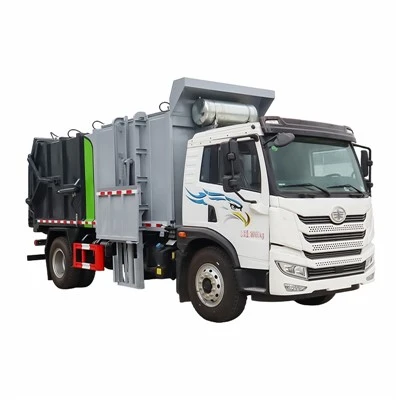
There’s also a special case for side loader trucks designed for animal waste, which is a growing niche in waste management. Animal waste is heavier than regular household waste, and it needs to be handled carefully to avoid spills or odors. The FAW 17m³ Animal Waste Side Loader Truck is built specifically for this purpose, and it uses a specialized AMT with a reinforced gearbox. The side loader’s lift arms pick up large, heavy bins from farms or feedlots, so the transmission needs to be able to handle the extra torque without slipping. The AMT’s automation also means the driver can focus on operating the side loader’s mechanism, which is designed to empty bins directly into the compaction chamber, instead of shifting gears repeatedly. We worked closely with our engineering team to customize the transmission for this truck, because animal waste routes have unique demands—stop-and-go driving over dirt roads, handling heavy loads, and needing to stay reliable in wet or muddy conditions.
Now, you might be wondering why garbage trucks don’t use CVTs (continuously variable transmissions) like the ones in some passenger cars. The simple answer is durability. CVTs use a belt or pulley system that can slip or wear out under the heavy torque and constant shifting of a garbage truck. Garbage trucks carry loads that can be 30,000 to 40,000 pounds when full, and the transmission has to handle that weight thousands of times over a year. AMTs and manuals have a more robust mechanical design that can stand up to that kind of use, while CVTs just aren’t built for that level of heavy-duty work. We tested CVTs on a small prototype compactor a few years ago, but after six months of use, the belt had stretched and needed to be replaced—something that would cost way more in downtime and repairs than the fuel efficiency gains would save. So for now, CVTs just aren’t practical for regular garbage truck use.
As a supplier, we’ve seen how transmission technology has evolved over the last 10 years, and it’s all tied to making garbage trucks more reliable, more fuel-efficient, and easier for drivers to operate. A few years ago, almost all garbage trucks had manual transmissions, but now 80% of the models we sell come with AMTs. That shift is because waste management companies are focused on reducing downtime and keeping drivers happy—fatigued drivers make more mistakes, and a truck that needs fewer repairs means more money in their pocket. We also work closely with our customers to match the right transmission to their specific needs. If a small town only has residential routes with narrow streets, we’ll recommend a manual or basic AMT for the Dongfeng 10m³ Garbage Compactor Truck. If a large city needs a truck that can handle thousands of pounds of commercial waste every day, we’ll point them toward the 22m³ Large Capacity Garbage Compactor Truck with its full automatic transmission. If a customer is dealing with animal waste or other specialized heavy loads, the FAW 17m³ Animal Waste Side Loader Truck’s customized AMT is the perfect fit.
At the end of the day, the transmission in a garbage truck isn’t just a part—it’s a key part of how the truck does its job. It’s what lets a driver pick up 50 bins in an hour without burning out, what lets a heavy compactor truck navigate a tight alleyway without getting stuck, and what keeps the truck running reliably for 10 or 15 years. If you’re in the market for a garbage truck and you’re not sure which transmission is right for your route, we’re here to help. We work with municipal governments, waste management companies, and private operators to find the right truck for their needs, whether that’s a small hooklift or a large compactor. Don’t hesitate to reach out to start a conversation about what kind of garbage truck will work best for you.
References:
- Heavy Duty Transmission Standards for Municipal Garbage Trucks. National Waste & Recycling Association, 2022.
- "Transmission Technology in Refuse Vehicles." Commercial Vehicle Technology Report, Vol. 18, No. 3, 2021.
- Durability Testing of Commercial Vehicle Transmissions. American Trucking Associations, 2023.
- Specialized Transmissions for Niche Waste Collection Applications. Waste Management Engineering Journal, Vol. 12, No. 2, 2022.