
Hospitals and EMS fleets should choose a battery-electric ambulance by testing the finished vehicle against its hardest routine assignment. It should carry the patient, crew and equipment within its permitted weight limits, complete the route with the agreed charge reserve, and be ready for the next call. Write those three requirements into the purchase specification so every bidder is working toward the same result.

Start with one assignment the vehicle must complete
Specify an electric ambulance for the busiest repeatable shift. Count outbound and return kilometres, repositioning and stationary patient-bay use between charging opportunities. Use a real shift from dispatch records to catch regular late calls and long gaps between charges.
|
Assignment |
What to reproduce in the test |
What to do if the vehicle falls short |
|
Scheduled hospital transfer |
A complete route with loading, handover and the return leg |
Assign a shorter route or change the charging window |
|
Urban emergency response |
Consecutive calls and a realistic delay before returning to base |
Cover longer calls with another unit or select a configuration with a larger usable energy margin |
|
Critical-care transfer |
The approved equipment load, clinical crew and continuous patient-bay operation |
Review the vehicle's payload and clinical layout before considering it for the route |
|
Longer regional transfer |
The longest routine round trip, including any verified charging stop |
Keep the route on a mixed fleet until the electric unit can complete the assignment with reserve |
Weigh the converted ambulance as it will be dispatched
Ask the supplier to list what its quoted vehicle weight already includes. Then add only the missing load, such as the crew, patient, carried equipment and supplies. During acceptance, use a weighbridge report for the completed vehicle or an equivalent test load, and check gross weight and each axle separately. Moving equipment can redistribute axle load. A gross weight overrun requires reducing the load or choosing a higher-capacity vehicle.
For example, assume a configured vehicle weighs 2,930 kg with its fixed conversion and installed stretcher, against a permitted gross weight of 3,500 kg. The initial difference is 570 kg. If the additional dispatch load is 420 kg, the remaining gross-weight margin is 150 kg. The axle readings still determine whether that load distribution is permitted. Record where the equipment and test weights were placed so the result can be reproduced.
Test the patient cabin during the handover your crews actually perform
Have clinical staff walk through rear loading, stretcher docking, staff access to the patient and the ability to secure equipment within reach. Use the specified stretcher, locking system and monitor mounts for the demonstration. Include the parking and loading space at your hospital if a high roof, ramp or long rear door swing could limit access.
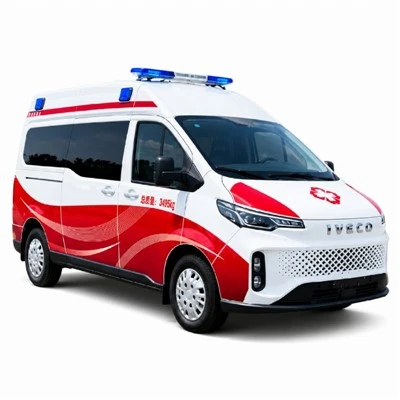
Hubei Ruitu Technology Co., Ltd. offers two starting layouts for a shared clinical brief. The Foton vehicle's published cabin height is at least 1.5 m, with an automatic loading stretcher and inverter among the options. The Maxus ICU van's specification table gives a medical bay of 2,710 × 1,730 × 1,710 mm (L × W × H). Use the Foton patient transfer layout to check cot loading and the Maxus ICU layout to review space for equipment and staff. Request a dimensioned drawing and a loaded axle-weight record for the build you will buy.

Define the route and recharge test before you accept delivery
Agree on the starting state of charge, minimum arrival reserve, test load, ambient conditions, patient-compartment settings and the time allowed for charging. For an illustrative 90 km test route, assume a start at 85% and a required finish at 25% or higher. A finish at 30% uses 55 percentage points and clears that acceptance target by five points. The result applies to that test configuration and those conditions. The buyer sets the actual target around its operating plan.
Replay the charging window with the proposed charger and record the charge recovered before the next scheduled departure. Hato Hone St John's first-year trial in New Zealand found that a 12-hour metropolitan shift could be completed under its operating conditions, while the need to return to station for charging limited the area the vehicle could cover. The useful comparison for another operator is the pattern of stop time and charger access. Hato Hone St John EV ambulance trial
For handover, collect the agreed build sheet, the vehicle identification number, the loaded weight record and the route and charge test results. Resolve any material deviations with the supplier before the ambulance enters its assigned service. Use the Electric Ambulance Procurement Pack to record the route, patient and equipment loads, charge reserve and handover checks. Share the completed Route Test and Acceptance Checklist with RUITU for configuration review.

FAQ
Can I choose an electric ambulance from the base van's range figure?
Use the base van figure for early screening. For the purchase decision, request a result for the completed ambulance under the agreed load, route, temperature and clinical equipment use.
Can one electric ambulance cover both transfer and ICU duties?
A shared vehicle may cover both assignments if the cabin, clinical equipment, legal classification, load limits and energy reserve meet both duty profiles. Demonstrate the more demanding one before relying on the vehicle for both.
What should I do if a supplier cannot reproduce my route before export?
Agree on a representative pre-shipment route, record the differences in speed, terrain, temperature and stationary operation, and schedule a local commissioning trial before full deployment.
Who should attend an electric ambulance demonstration?
Include a fleet representative, a clinical crew member and the person responsible for charging. They can respectively sign off the vehicle and load, clinical workflow and charger readiness.
How can I check whether a larger battery is worth specifying?
Run the same route and cabin load against both configurations, then compare charge reserve and loaded axle weights. Ask for the time needed to restore the next shift's starting charge on your depot charger.