
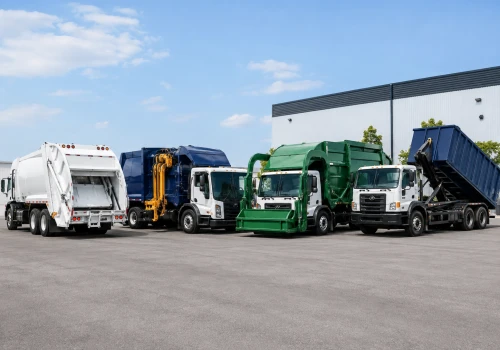
Choosing a garbage truck is not simply a matter of deciding how many cubic meters of waste the body can hold.
Two trucks with the same body capacity can perform very differently once they are placed on an actual collection route.
The right vehicle depends on the type and density of waste, collection frequency, road width, container system, crew size, travel distance to the disposal facility and even how many stops the truck makes during a normal shift.
That is why understanding the different types of garbage trucks matters to municipalities, waste-management contractors, distributors and private fleet operators.
A rear loader may be ideal for one residential collection route, while a side loader can perform the same job with fewer crew members. A hook-lift truck may be a far better choice for construction waste, while a front loader makes more sense where large commercial dumpsters dominate the collection network.
This guide explains the main garbage truck types, how their loading systems work, where each configuration performs best and what professional buyers should evaluate before choosing a waste collection vehicle.
1. Garbage Trucks Should Be Selected Around the Collection System
One of the most common mistakes in waste-truck procurement is starting with vehicle capacity.
A buyer may request:
"We need a 10 cubic meter garbage truck."
But capacity alone tells a manufacturer very little.
A more useful starting point is:
What waste will the truck collect, how will that waste be presented at the collection point, and what happens after it is loaded?
For example, consider three 10 m³ trucks.
One may collect household waste from small roadside bins and compact it immediately.
Another may lift standardized wheeled containers automatically.
A third may transport a detachable container filled with construction waste.
Although their nominal body capacities appear similar, they are completely different vehicles from an operational perspective.
Before selecting the truck, define:
Waste type
Waste density
Daily collection volume
Collection container type
Number of stops per route
Road width
Crew size
Distance to transfer station or landfill
Loading method
Unloading requirements
Once these factors are known, choosing between the different types of garbage trucks becomes much easier.
2. Rear Loader Garbage Truck
The rear loader garbage truck is one of the most widely recognized waste collection vehicles.
Waste is loaded into a hopper at the rear of the truck. A hydraulic packing mechanism then pushes and compresses the material into the main body.

Depending on the configuration, workers can load loose refuse manually or use a bin-lifting mechanism to empty wheeled containers into the hopper.
Where Rear Loaders Work Best
Rear loaders are particularly suitable for:
Residential neighborhoods
Municipal household waste
Mixed collection routes
Areas using several different bin sizes
Routes where manual collection is still common
Narrow or irregular streets
Their biggest advantage is flexibility.
Because loading takes place at the back of the vehicle, crews can collect bags, small containers and standardized garbage bins without requiring highly specialized roadside infrastructure.
For municipalities operating mixed collection systems, this can be important.
What Buyers Should Consider
Rear-loading collection usually requires workers to operate close to the back of the truck.
Fleet operators should therefore consider:
Rear visibility
Camera systems
Emergency stop controls
Worker access
Step design
Bin lifter compatibility
Hydraulic safety protection
Another consideration is labor.
A rear loader may be extremely versatile, but a route requiring several collection workers can have higher long-term labor costs than a more automated system.
For markets where labor availability is changing rapidly, this deserves serious attention.
3. Side Loader Garbage Truck
A side loader garbage truck collects waste from the side of the vehicle rather than the rear.
Some side loaders use manual or semi-automatic loading systems, while more advanced models use a hydraulic arm to lift standardized containers directly into the truck.
This can dramatically change route efficiency.
Why Side Loaders Are Popular
An automated side loader may allow a driver to approach a container, lift it, empty it and return it to the collection point without leaving the cab.

This makes the configuration attractive for:
Residential curbside collection
Standardized wheeled-bin systems
Low-density suburban routes
Long collection routes
Fleets seeking lower labor requirements
Where bins are consistently positioned, automated collection can reduce the time required at each stop.
The Limitation: The Route Must Fit the Truck
Automation works best when the waste collection network has been designed around it.
A side loader may be less effective when:
Cars regularly block bins
Containers vary greatly in size
Waste is placed randomly
Streets are extremely narrow
Collection occurs on both sides of a road
Overhead or roadside obstacles restrict arm movement
This illustrates an important purchasing principle:
The most automated garbage truck is not automatically the most efficient garbage truck.
The collection infrastructure must support the technology.
4. Front Loader Garbage Truck
A front loader garbage truck uses two lifting arms mounted at the front of the vehicle.
The arms engage with a compatible commercial waste container, lift it over the cab and empty the contents into the body.

The waste is then compacted.
This system is particularly common in commercial and industrial collection.
Typical Applications
Front loaders are well suited for collecting waste from:
Shopping centers
Hotels
Restaurants
Apartment complexes
Industrial facilities
Warehouses
Commercial districts
Large institutions
These locations often generate significant volumes of waste at a single collection point.
Instead of collecting dozens of small household bins, the truck empties a smaller number of large dumpsters.
That is where the front-loader concept becomes efficient.
Why Container Compatibility Matters
The collection container is part of the vehicle system.
A front loader cannot simply pick up every container it encounters.
Container dimensions, lifting pockets, weight and truck lifting capacity need to match.
For buyers developing a new waste collection system, it may therefore make sense to procure trucks and compatible containers as one project rather than as separate purchases.
5. Garbage Compactor Truck
A garbage compactor truck, sometimes called a waste compactor truck or refuse compactor truck, uses hydraulic pressure to reduce the volume of collected refuse inside the body.
In many markets, this is the standard choice for municipal solid waste.
Rear loaders, side loaders and front loaders can all incorporate compaction systems, so "compactor truck" describes a function rather than only one loading position.
Why Compaction Matters
Municipal household waste often contains large amounts of low-density material.
Without compaction, a truck may fill its available volume long before reaching its permitted payload.
Compression allows more waste to be carried during each trip, potentially reducing:
Disposal trips
Fuel consumption per tonne collected
Route interruptions
Driver hours
Fleet size requirements
However, higher compaction is not always automatically better.
If extremely dense material is loaded into the body, the truck may reach its legal axle or gross vehicle weight limit before its volumetric capacity is fully used.
This is why professional garbage-truck specification requires both:
volume analysis and weight analysis.
6. Hook Lift Garbage Truck
A hook lift garbage truck uses a hydraulic hook mechanism to load and unload detachable containers.
Rather than permanently attaching one waste body to the chassis, the vehicle transports interchangeable containers.

This makes the system highly versatile.
Typical Applications
Hook-lift trucks are often used for:
Construction and demolition waste
Industrial waste
Recycling
Bulk refuse
Scrap
Municipal transfer operations
Landscaping waste
Temporary waste collection points
One chassis can service several containers.
A container can remain at a customer site while it is being filled, allowing the truck itself to continue working elsewhere.
Why This Can Improve Fleet Utilization
With a conventional fixed-body garbage truck, the chassis and container are always together.
With a hook-lift system, they are separate operating assets.
For example, an operator may own:
5 hook-lift trucks
20 detachable containers
Containers can remain at construction sites, factories or community collection points while the trucks continuously rotate between locations.
This can increase chassis utilization significantly.
Hook Lift vs Roll Off Garbage Truck
The terms hook lift garbage truck and roll off garbage truck are sometimes used interchangeably in online searches, but the loading mechanisms are not always identical.
Hook-lift systems use a hydraulic hook to engage the container.
Cable-style roll-off systems use a winch and cable mechanism.
Both serve similar bulk-container applications, but container compatibility, loading angle, maintenance requirements and operating speed can differ.
Buyers should specify which loading mechanism their existing container network uses.
7. Swing-Arm Garbage Truck
A swing-arm garbage truck uses lifting arms to load detachable waste bins or containers onto the truck.
It remains a practical solution in markets where simple mechanical systems and lower acquisition costs are priorities.
Common applications include:
Community waste collection
Construction areas
Factories
Schools
Rural collection points
Small municipal transfer systems
The design is mechanically straightforward and can work well where collection containers are standardized.
However, compared with more advanced hook-lift systems, container handling flexibility may be more limited.
The best choice depends on the existing waste-bin system rather than on the truck alone.
8. Sealed Dump Garbage Truck
A sealed dump garbage truck transports waste inside an enclosed or covered body and unloads it by tipping the body.
Compared with a compactor, the structure is relatively simple.
This configuration may be suitable for:
Loose municipal waste
Landscaping material
Relatively dense refuse
Short-distance collection
Markets prioritizing simple maintenance
Because there is no complex compression mechanism, maintenance can be easier.
The trade-off is lower volumetric efficiency when transporting lightweight, bulky household waste.
For that reason, a sealed dump truck may perform well with dense refuse but poorly on a route dominated by packaging, plastic and other low-density materials.
9. Small Garbage Trucks and Mini Refuse Vehicles
Not every waste collection route requires a full-size truck.
Compact refuse collection vehicles are increasingly useful in:
Old city districts
Markets
Pedestrian areas
Residential compounds
Tourist zones
Narrow streets
Villages
Gated communities
A small garbage truck may sacrifice payload and body capacity, but it can reach areas that larger vehicles cannot access.
Some municipalities use a two-stage collection system.
Small vehicles collect waste from neighborhoods and transport it to a local transfer point. Larger compactor trucks or transfer vehicles then move the waste to the final disposal facility.
In the right environment, this can be more efficient than forcing a large garbage truck through every street.
10. How Do the Main Garbage Truck Types Compare?
| Garbage Truck Type | Best For | Main Advantage | Main Limitation |
|---|---|---|---|
| Rear Loader | Residential and mixed municipal waste | Flexible loading | Higher labor requirement |
| Side Loader | Standardized curbside bins | Automated collection | Requires organized bin placement |
| Front Loader | Commercial dumpsters | High-volume commercial collection | Requires compatible containers |
| Compactor Truck | Municipal solid waste | High volumetric efficiency | More hydraulic complexity |
| Hook Lift Truck | Bulk and construction waste | Interchangeable containers | Requires container system |
| Swing-Arm Truck | Community collection | Simple and economical | Less flexible than hook lift |
| Sealed Dump Truck | Dense or loose waste | Simple maintenance | Limited compaction |
| Mini Garbage Truck | Narrow urban areas | Excellent maneuverability | Lower payload |
This table provides a useful starting point, but professional fleet selection requires more than identifying the waste category.
11. Waste Density Can Change the Right Truck Choice
Waste density is one of the most important technical factors in garbage-truck selection, yet it is often ignored during early inquiries.
Consider two trucks with the same nominal body volume.
One transports low-density household packaging.
The other carries wet organic waste or dense industrial material.
They may reach completely different operating limits.
For low-density refuse, body volume may be the main limitation.
For high-density waste, legal vehicle weight or axle load may become the limitation first.
This is why simply requesting a "20 m³ garbage truck" is not enough for professional vehicle engineering.
The manufacturer should understand what will actually go inside the body.
12. Route Density Is Just as Important as Waste Volume
Imagine two municipalities collecting the same amount of waste per day.
City A has apartment buildings with large communal bins every few hundred meters.
City B has thousands of individual houses, each with its own small bin.
Daily waste tonnage may be similar, but the vehicle operating cycle is completely different.
City B may require far more:
Stops
Accelerations
Braking events
Bin-lifting cycles
Driver movements
Hydraulic operations
That affects:
Fuel consumption
Brake wear
hydraulic-system duty
labor requirements
transmission selection
Therefore, the best garbage truck for municipal waste depends on route structure as much as total waste tonnage.
13. How Far Is the Landfill or Transfer Station?
Collection efficiency can fall rapidly when a garbage truck spends too much of its shift traveling between the collection route and disposal facility.
Suppose a truck becomes full every two hours.
If the landfill is five minutes away, this may not be a major problem.
If the landfill is 45 minutes away, each unloading cycle removes a substantial amount of productive collection time.
Possible solutions include:
Larger-capacity trucks
Higher compaction efficiency
Local transfer stations
Separate waste-transfer vehicles
Professional fleet planning should therefore evaluate the complete waste movement chain, not just the collection vehicle.
14. Chassis Selection Matters More Than Many Buyers Expect
The waste body is highly visible, but the chassis determines whether the completed truck can carry and operate that body reliably.
Key specifications include:
GVW
Gross vehicle weight determines the total legal operating mass.
Axle Capacity
Garbage bodies can create significant rear-axle loads, particularly when waste is compacted.
Wheelbase
A shorter wheelbase may improve maneuverability, while a longer chassis may accommodate a larger body.
Engine Torque
Frequent stop-start operation with a fully loaded truck can be demanding.
Transmission
Transmission choice should reflect route speed, terrain and stop frequency.
Suspension
The suspension must handle repeated loading cycles and variable payload.
Braking System
Urban refuse collection creates frequent braking events.
PTO Compatibility
Hydraulic systems normally depend on a power take-off or other power source.
A garbage body should never be selected independently of chassis capability.
15. Should You Choose 4x2, 4x4, 6x4 or 8x4?
Drive configuration depends largely on vehicle size and operating environment.
4x2
Common for small and medium municipal garbage trucks operating on paved roads.
Advantages include:
Lower initial cost
Good maneuverability
Lower fuel consumption
Easier maintenance
4x4
Useful where collection routes include:
Mud
Snow
Rural roads
Construction sites
Mining areas
Poor road surfaces
However, four-wheel drive adds weight, cost and mechanical complexity.
6x4
Often used for larger-capacity trucks requiring higher payload.
It can be suitable for heavy municipal, construction or bulk waste applications.
8x4
Used where very high payload or large bodies are required and local road regulations permit the configuration.
Again, bigger is not always better.
A large truck may provide excellent payload but perform poorly in dense neighborhoods with tight turning spaces.
16. Manual Loading vs Automated Loading

Automation is one of the biggest differences between modern waste collection systems.
A highly automated truck can reduce crew size, but only when local collection infrastructure supports it.
Before choosing automated loading, evaluate:
Bin standardization
Container positioning
Roadside parking
Street width
Driver visibility
Collection-side consistency
Maintenance capability
Operator training
For some cities, an automated side loader can transform productivity.
For another city with irregular bins and informal roadside waste, a rear loader with flexible manual loading may remain much more effective.
Technology should match operations.
Operations should not be forced to match an unsuitable truck.
17. Hydraulic System Reliability Is Critical
Garbage trucks perform far more hydraulic cycles than many other specialized vehicles.
During a single shift, the system may repeatedly operate:
Bin lifters
Packing plates
Scrapers
Tailgates
Ejection systems
Hook-lift mechanisms
Container arms
Hydraulic reliability therefore deserves close attention when comparing suppliers.
Buyers should ask about:
Pump specification
Valve system
Cylinder construction
Hose routing
Hydraulic pressure
Filtration
Service access
Emergency controls
A truck with an impressive body design but difficult hydraulic maintenance may create unnecessary downtime over its working life.
18. Do Not Choose a Truck Only by Body Capacity
This deserves repeating because it is one of the most common procurement errors.
A 12 m³ truck from one supplier is not automatically equivalent to a 12 m³ truck from another.
Buyers should also compare:
Chassis GVW
Payload
Axle ratings
Body material
Loading system
Compaction mechanism
Hydraulic components
Bin compatibility
Loading height
Unloading method
Safety features
Serviceability
The real question is not:
"How big is the garbage body?"
It is:
"How much of my actual waste can this truck collect safely and efficiently during one working cycle?"
That is a much more useful procurement question.
19. Which Garbage Truck Is Best for Different Applications?
Residential Household Waste
A rear loader or side loader is usually the strongest candidate.
Choose between them based largely on bin standardization and available labor.
Commercial Waste
A front loader can be highly efficient when businesses use compatible large dumpsters.
Construction Waste
A hook-lift or roll-off system is normally more practical than a conventional municipal compactor.
Narrow Urban Streets
A mini garbage truck or compact rear loader may provide better access.
Rural Collection
Durability, ground clearance, simple maintenance and potentially 4x4 capability may matter more than maximum automation.
Industrial Waste
Waste density and container format should drive the decision. Hook-lift and detachable-container systems are often useful.
High-Volume Municipal Waste
Large garbage compactor trucks can reduce the number of disposal trips, provided the road network can accommodate the vehicle dimensions.
20. What Should Buyers Tell a Garbage Truck Manufacturer?
A professional inquiry should include more than body volume.
Before requesting a final quotation from a garbage truck manufacturer, provide:
Destination country
Waste type
Approximate waste density if known
Daily collection volume
Preferred body capacity
Existing garbage-bin dimensions
Loading method
Number of collection workers
Typical road conditions
Distance to landfill or transfer station
Required drive configuration
Emission standard
Left-hand or right-hand drive
Preferred chassis brand
Required certifications
Quantity
This information allows the manufacturer to recommend a vehicle based on actual operations rather than simply quoting the largest available body.
21. How to Compare Two Garbage Truck Quotations
When comparing two garbage trucks for sale, do not place price at the top of the spreadsheet and stop there.
Compare the complete system.
A useful evaluation should cover:
Chassis specification
Legal payload
Body capacity
Body construction
Hydraulic system
Control system
Container compatibility
Compaction design
Safety systems
Spare parts
Warranty
Operator training
Technical documentation
Local serviceability
A cheaper truck that collects fewer tonnes per shift, requires more workers or experiences more downtime may become the more expensive vehicle over its service life.
That is why professional fleet operators increasingly evaluate total cost of ownership, not only acquisition price.
22. Garbage Truck Procurement Checklist
Before placing an order, confirm:
Waste type has been defined
Waste density has been considered
Collection route has been analyzed
Container sizes are confirmed
Loading mechanism matches the container system
Body capacity is appropriate
Payload has been calculated
Axle loads are acceptable
Chassis GVW is sufficient
Drive configuration matches the road
Turning radius suits collection streets
Hydraulic system is suitable for expected duty cycle
Safety controls are included
Spare parts are available
Local maintenance capability has been considered
Destination-country regulations are confirmed
The right specification can prevent years of operational compromises.
Frequently Asked Questions About Garbage Truck Types
What are the main types of garbage trucks?
The main types of garbage trucks include rear loaders, side loaders, front loaders, garbage compactors, hook-lift trucks, roll-off trucks, swing-arm trucks, sealed dump trucks and small refuse collection vehicles.
Each design serves a different collection system.
Which garbage truck is best for household waste?
Rear-loader and side-loader garbage trucks are commonly used for household waste.
Rear loaders provide more flexibility where collection methods and bins vary. Automated side loaders can reduce labor requirements where standardized curbside containers are used.
What is the difference between a garbage compactor truck and a normal garbage truck?
A garbage compactor truck compresses waste inside the body, allowing more low-density refuse to be carried before the vehicle needs to unload.
Not every garbage truck requires compaction. Hook-lift and dump-type vehicles, for example, may transport waste without compressing it.
What type of garbage truck is used for dumpsters?
Front loaders are commonly used for large commercial dumpsters.
Hook-lift and roll-off trucks are typically used for much larger detachable containers used at construction sites, factories and bulk-waste locations.
What type of garbage truck is best for construction waste?
Hook-lift or roll-off trucks are usually strong choices because detachable containers can remain at the construction site while they are being filled.
Is a side loader better than a rear loader?
Neither is universally better.
A side loader can reduce labor and improve productivity when standardized bins are properly positioned.
A rear loader provides greater flexibility for mixed bins, bagged refuse and irregular collection conditions.
What size garbage truck should I buy?
Body size should be determined after considering waste density, daily collection volume, chassis payload, road width, route length and distance to the disposal facility.
Capacity alone should not determine the vehicle.
Final Thoughts
Understanding the different types of garbage trucks is the first step. Matching the truck to the collection system is what determines whether the investment performs well over the next several years.
A municipality collecting standardized residential bins does not have the same operating needs as a contractor handling construction debris. A commercial waste operator collecting large dumpsters faces different challenges from a fleet working in narrow urban streets.
The most effective waste collection vehicle is therefore not necessarily the truck with the largest body, highest compaction pressure or most automated equipment.
It is the truck that allows the operator to collect the greatest practical amount of waste safely, reliably and economically within the conditions of the actual route.
Before selecting between a rear loader garbage truck, side loader garbage truck, front loader garbage truck, garbage compactor truck or hook lift garbage truck, define the waste stream, collection container, route and disposal process first.
Then build the vehicle specification around those answers.
That approach leads to better fleet utilization, fewer unnecessary disposal trips, lower operating costs and a waste collection system that works in practice-not just on a specification sheet.