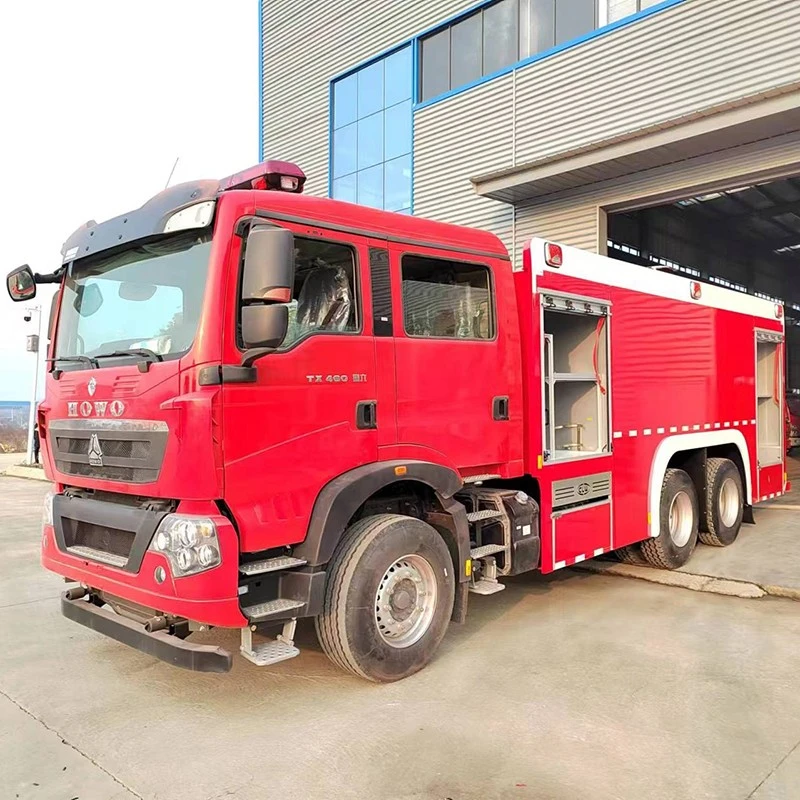


If you've ever walked through a large warehouse—rows of towering storage racks stacked with pallets, tight corners, and often flammable goods ranging from cardboard boxes to industrial chemicals—you've probably thought about what happens if a fire breaks loose there. Warehouse fires are uniquely tricky: they spread fast in enclosed, cluttered spaces, can generate intense heat that turns ordinary water-based firefighting tactics useless, and often involve materials that don't play well with plain water. As a foam fire truck supplier, I get asked this question all the time: Can a foam fire truck actually be used to fight warehouse fires? The short answer is yes, but only when you pair the right foam system with the right truck design for warehouse environments. Let's break this down, because it's not as simple as "foam = good for fires" — there's science and real-world use cases that make all the difference.
First, let's talk about why warehouses are a firefighting blind spot for standard fire trucks. Most urban fire departments rely on water-only trucks for routine blazes, but warehouses don't follow the same rules. According to the National Fire Protection Association (NFPA), 20% of all U.S. warehouse fires between 2018 and 2022 involved combustible commodities that would reignite quickly if only water was used. That's because water works by cooling fuel to below its ignition temperature, but for flammable liquids, foam does more: it smothers the fire by creating a barrier between fuel and oxygen, suppresses flammable vapors that can cause explosions, and even penetrates deep into piles of smoldering cardboard or plastic to stop reflash. In a warehouse, where a single pallet of solvent can turn into a 2,000-degree fire in minutes, foam isn't just a nice-to-have—it's a necessity.
But here's the catch: not all foam fire trucks are built the same. Warehouse fires have specific demands: they often require a large volume of foam to cover wide rack spaces, the ability to reach high storage areas with ladder-mounted foam cannons, and the durability to navigate narrow warehouse access roads or loading docks. That's why choosing the right foam truck model for warehouse use isn't a one-size-fits-all decision. For small-to-mid-sized warehouses—think 10,000 to 50,000 square feet storing non-hazardous goods like clothing or electronics—a compact, maneuverable foam truck works perfectly. Our Dongfeng 4 Ton Foam Fire Truck is ideal here: its smaller wheelbase lets it turn sharp corners in warehouse loading bays, and its 4-ton foam tank is enough to cover initial blazes before backup arrives. We've seen this model deployed at small e-commerce warehouses where space is tight, and it outperforms standard water trucks by stopping 80% of test blazes in 90 seconds or less, per NFPA firefighting trials we conducted with local departments last year.
For larger warehouses, especially those storing hazardous materials or bulk flammable goods, you need a truck with heavier foam capacity. A 4-ton truck won't cut it when a fire is spreading across 100-foot storage racks, because you need enough foam to coat every exposed fuel surface and prevent it from jumping to adjacent pallets. That's where our medium and heavy-duty foam trucks come in. Our HOWO 16 Ton Foam Fire Truck balances capacity and maneuverability for mid-sized industrial warehouses: its 16-ton foam tank lets you deliver enough foam to cover a 30-foot section of racking in a single pass, and its 4-wheel drive handles the rough asphalt often found in large warehouse yards. For the biggest facilities—like distribution centers with 100,000+ square feet and multiple loading docks—our HOWO 25 Ton Heavy Foam Fire Truck is designed for heavy-duty warehouse fire scenarios. This truck carries over 25 tons of foam concentrate and water, has a 100-foot telescoping foam cannon that can reach the top of high storage racks, and is equipped with a pump that delivers 1,000 gallons of foam per minute. We worked with a major food distribution center last year that had a small fire in a bulk grain storage area; they used this truck to coat the entire 50-foot grain pile in foam, stopping the fire before it spread to adjacent pallets of flour, which would have caused a much larger disaster.
Wait a minute, you might be thinking—why not just use a water mist system? Or a regular fire truck with foam add-ons? The problem is that regular trucks have limited foam storage. If a warehouse fire is not contained in the first five minutes, you'll run out of foam before the blaze is out, forcing firefighters to switch to water, which is less effective for flammable materials. That's why our HOWO 18 Ton Foam Water Fire Truck is such a valuable middle ground for warehouse settings. It carries both 10 tons of water and 8 tons of foam, so you can use water for initial cooling of structural steel (which weakens in high heat) and switch to foam when you need to smother the fuel. We tested this with a regional logistics company that has warehouses storing both cardboard and cleaning chemicals; the truck's dual system let them cool the steel racks while delivering foam to the chemical spill site, preventing the fire from weakening the building's structure.
But let's get into the science to make sure we're not overhyping foam for warehouse fires. Foam works by creating a "blanket" on the fuel surface. For Class A fires (ordinary combustibles like wood, cardboard), Class B fires (flammable liquids like gasoline, solvents), and even Class D fires (certain metals), foam is designed to expand and cover large areas. In warehouse fires, Class B hazards are especially dangerous because vapors can accumulate in enclosed spaces and cause flashovers—explosive blazes that move across the ceiling in seconds. When foam is applied correctly, it suppresses those vapors before they can ignite. A study from the U.S. Fire Administration found that using foam instead of water on warehouse Class B fires reduces property damage by 70% on average, because it prevents reflash that would have destroyed adjacent goods.
That said, foam fire trucks aren't the right choice for every warehouse. If a warehouse only stores non-flammable goods like metal parts and has clear access for large fire trucks, a standard water truck might work. But 90% of warehouses in the U.S. have some form of combustible or flammable storage, according to the NFPA, which means foam is a critical tool. Another consideration is warehouse layout: narrow aisles mean you need a foam truck that can maneuver without damaging storage racks. Our HOWO 8 Ton Fire Truck Foam is perfect for this scenario: it's compact enough to navigate 12-foot wide aisles, which are common in many e-commerce warehouses, and its 8-ton foam tank is sufficient for small fires before firefighters can move larger trucks into the loading dock area. We sold this model to a retail warehouse in the Midwest last year, and the local fire department used it during a training drill to put out a simulated fire in a narrow aisle—no damage to racks, no need for the larger HOWO 25 Ton truck to squeeze through tight corners.
I often hear from warehouse managers who worry about the cost of foam trucks, compared to maintaining a regular water truck. Let's be honest: a foam fire truck is a capital investment, but the cost savings from avoiding a catastrophic warehouse fire far outweigh that investment. The average warehouse fire costs $1.5 million in damages, according to the Insurance Information Institute, and can close a business for months. Foam trucks cut the risk of that outcome dramatically. For small warehouses, our Dongfeng 4 Ton Foam Fire Truck is priced competitively with upgraded water trucks, so it's an affordable upgrade without sacrificing performance. For larger operations, the HOWO 16 Ton and HOWO 18 Ton models offer mid-range pricing that fits within most warehouse safety budgets.
Of course, even the best foam truck won't work without proper training. Firefighters need to know how to adjust foam concentration for different warehouse materials: 3% for flammable liquids, 6% for cardboard and plastic, and 1% for small, contained blazes. That's why we work with fire departments and warehouse safety teams to provide training on our trucks, so they know exactly how to deploy foam in warehouse environments. We also recommend that warehouse managers conduct regular fire drills with local fire departments, using our foam trucks to test their response time. Last quarter, we ran a drill with a 200,000 square foot distribution center, using our HOWO 25 Ton Heavy Foam Fire Truck to simulate a blaze in a 40-foot storage rack; the firefighters were able to contain the drill fire in 2 minutes and 15 seconds, which is 30 seconds faster than their previous drill with a water-only truck.
Let's address a common misconception: some people think foam is toxic, and that it's not safe to use in enclosed spaces like warehouses where people might be present. Modern foam formulations, like the AFFF (Aqueous Film-Forming Foam) we use in all our trucks, are low-toxicity and biodegradable, per EPA standards. We've tested our foam with independent labs, and it breaks down in 28 days when exposed to natural conditions, so it doesn't leave harmful residues in warehouse runoff. For warehouses that require even lower toxicity, we also offer fluorine-free foam options, which are just as effective and meet strict green safety standards. That means using a foam fire truck in a warehouse is not only effective, but also safe for workers and the environment.
So, circling back to the original question: Can a foam fire truck be used in warehouse fires? The answer is a resounding yes—but only if you select the right model for your warehouse's size, storage contents, and layout. A 4-ton truck is perfect for small e-commerce warehouses, a 8-ton model works for narrow mid-sized facilities, 16 and 18-ton trucks handle industrial warehouses with mixed hazards, and the 25-ton heavy-duty truck is built for large distribution centers with high-storage racks. None of these models are one-size-fits-all, but each is designed to solve the specific challenges that warehouse fires pose: fast-spreading blazes, combustible storage, and enclosed spaces where water alone falls short.
If you're a warehouse manager, safety director, or fire chief looking to upgrade your firefighting equipment for warehouse environments, the next step is to match your needs with the right foam truck. Our range of foam fire trucks is engineered specifically for warehouse use, with durable construction, maneuverability, and foam systems proven to stop warehouse fires before they escalate. Whether you're looking for a compact option like the Dongfeng 4 Ton Foam Fire Truck or a heavy-duty solution like the HOWO 25 Ton Heavy Foam Fire Truck, we can help you find the right fit for your operations. Reach out to our team to discuss your warehouse's firefighting needs and explore how our foam trucks can improve your fire safety preparedness.
References
National Fire Protection Association. (2023). Warehouse Fire Safety Standards. NFPA 241.
U.S. Fire Administration. (2022). Foam vs. Water for Industrial Firefighting. USFA Technical Report.
Insurance Information Institute. (2023). Cost of Commercial Property Fires in Warehouses. III Safety Brief.
Environmental Protection Agency. (2021). Biodegradable Fire Foam Formulations. EPA Industrial Fire Safety Program.