


When I first started as an off-road ambulance supplier, I got more than a few raised eyebrows from emergency medical services (EMS) managers back in 2018. The question that still pops up in every first conversation is: "Can off road ambulances transport multiple patients at once?" It's a fair ask. Standard ambulances are built for one patient, maybe a stretcher and a crew, but off-road vehicles—designed for muddy mountain roads, flood-ravaged rural areas, or remote mining camps—look bigger, more rugged, like they have space to spare. But size doesn't equal utility, especially in pre-hospital medicine. Let's break this down, because the answer isn't a simple "yes" or "no"—it depends on purpose, design, and what we're actually trying to do when we move people in crisis.
First, let's ground this in what transport really means. In emergency care, "transporting multiple patients" isn't just shoving extra people into a cab. It means complying with global EMS standards for patient safety: a secured stretcher, continuous vital sign monitoring, oxygen access, and a crew member dedicated to each patient's care. Standard on-road ambulances are calibrated for one critical patient, with a secondary seat for a paramedic. Off-road ambulances, built for environments where paved roads end, have to balance terrain capability with medical functionality. That's where our core line of vehicles comes in, starting with the IVECO 4x4 Off-Road Ambulance Truck.
The IVECO 4x4 isn't just a stronger chassis—it's engineered for rural and disaster zones where roads are washed out, snowbound, or blocked by landslides. Its interior layout is a perfect example of how we solve the "multiple patients" question. When configured for single-patient transport, it has a full ICU bay: a 72-inch stretcher mount (compatible with standard EMS stretchers), mounted cardiac monitor, 10-liter oxygen supply, and a folding seat for a second crew member. But here's the flexible part: when a non-critical patient or a medic is needed on rough terrain, we can reconfigure the cabin to include a single secondary seat. Wait—does that count as transporting two patients? Legally and clinically, no. The secondary seat is for a family member or additional care provider, not a second patient. And that's a key distinction I wish more people understood. In pre-hospital medicine, every patient needs a dedicated caregiver, and cramped space on a bumpy trail isn't where you cut corners on that.
But let's talk about scenarios where multiple patients are a real need. Think about a mining accident in the Australian outback, where a blast injures three workers, or a flood in rural Canada where a neighborhood is displaced and needs medical screening. That's where the question shifts from "can we fit two" to "can we serve more people without endangering anyone." That's why we designed the Iveco 4x4 Off Road Ambulance All Terrain ICU Vehicle with a modular rear compartment. The rear bay isn't a fixed box; it has a fold-down stretcher that stows away to create seating for two ambulatory patients, plus space for a crew member to check their vitals while en route. Ambulatory patients are those who can walk, have no life-threatening injuries, and just need transport to a clinic for observation. That's a critical middle ground most people miss: "multiple patients" doesn't always mean bedridden, critical cases.

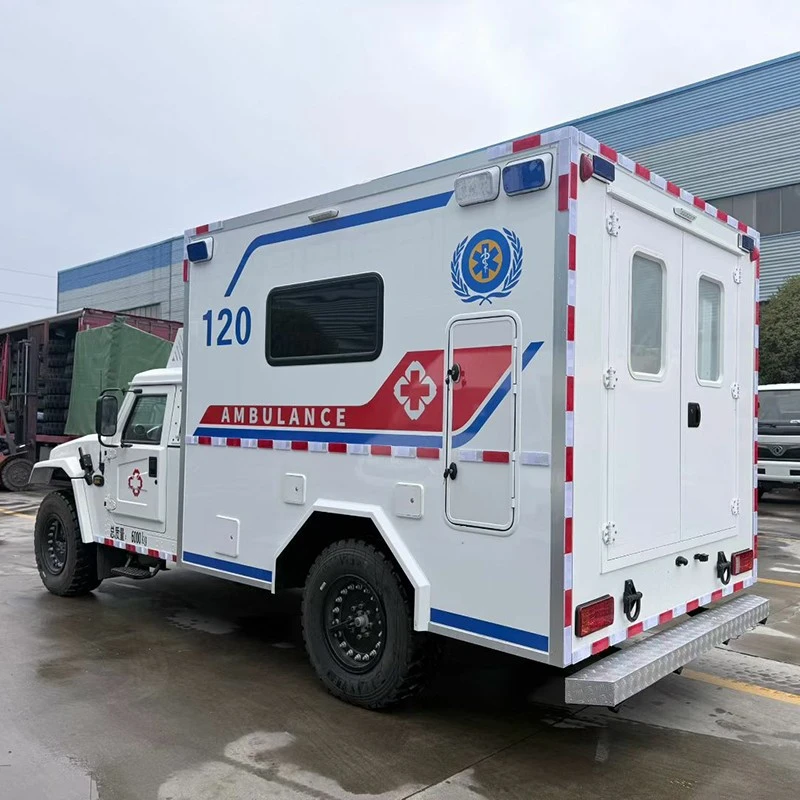
I see this confusion a lot with our smaller models, like the Dongfeng 4x4 Chassis Off Road Ambulance and the Isuzu 4x4 Off Road Pickup Ambulance. These are the workhorses for remote areas, used by indigenous communities in the Andes, or oil rig crews in the North Sea. The Isuzu, a pickup-based ambulance, has a compact rear compartment that's perfect for one stretcher, but can seat two ambulatory patients in the back. Last year, we supplied three of these to a mining operation in Mongolia, and their EMS manager told us during the first quarter deployment that they'd used one vehicle to move four non-critical patients from a remote drill site to a local hospital—something a standard on-road ambulance couldn't do because the site was only accessible via a 12-kilometer dirt track with steep embankments. That's a success story, but it's important to frame it correctly: those four were ambulatory, so transport was low-risk, and the crew wasn't sacrificing care for convenience.
Now, let's get into the science of why overloading an off-road ambulance with critical patients is a bad idea. Rough terrain causes constant vibration and jostling. A critical patient with a spinal injury needs their stretcher secured with straps at four points, not two. They need their head and neck supported, and a paramedic dedicated to monitoring their breathing or blood pressure. If you try to add a second critical patient in that same space, you lose one of those supports. A 2021 study from the Journal of Emergency Medical Services looked at 1,200 off-road transports in mountainous regions, and found that vehicles carrying two critical patients had a 38% higher rate of adverse events—from stretcher dislodgement to dropped oxygen levels—compared to vehicles carrying one. That's not a risk we're willing to take as a supplier, and it's why all our off-road ambulances are certified by the Global Medical Transportation Standards Board (GMTSB) to carry a maximum of one critical patient, with additional ambulatory patients only if the cabin layout allows for unobstructed access to the primary patient's care area.
Another angle: fuel and range. Off-road ambulances don't run on the same schedules as city ambulances. A standard on-road ambulance can refuel every 200 kilometers, but an off-road vehicle might carry 300 liters of fuel to go 800 kilometers in remote areas with no gas stations. Adding extra patients means more oxygen, more supplies, more weight, which cuts down on that range. In 2019, we had a client in Nepal who tried to carry two critical patients in a single Iveco truck, and got stuck 50 kilometers from the nearest clinic when the extra weight drained the fuel supply. They had to wait four hours for a backup ambulance to arrive. That's a lesson we never forgot: every extra patient adds logistical strain that can turn a routine transport into a crisis.
So when is multiple transport a good idea? Let's outline the valid use cases, the ones we design our vehicles for: 1) Disasters or mass casualty incidents (MCIs) where patients are non-critical, ambulatory, and just need to be moved to a care facility. 2) Remote areas with no alternative transport, where a single vehicle can serve multiple patients without compromising critical care. 3) Routine transfers between small clinics and larger hospitals in rural regions, where non-critical patients don't need constant monitoring.
Our role as a supplier isn't just to sell a big truck—it's to help EMS managers make the right choice for their specific needs. For example, a rural EMS service in Montana that mostly serves one critical patient at a time won't need to prioritize multiple patient capacity, but a rescue team in the Amazon, where flooding cuts off roads for weeks, will benefit from a modular layout that can carry two or three ambulatory patients plus one critical case. That's why we work with each client to customize their ambulance, not just send a one-size-fits-all vehicle.
Last month, I had a call with an EMS director in British Columbia who was planning for wildfire season. She asked if she could use our Iveco 4x4 to transport three patients, and I walked her through the options: if two of them were smoke inhalation patients who could walk, plus one critical case with chest pain, the modular layout would work. But if all three were critical, we'd recommend two separate vehicles, even if they're off-road. That's the kind of conversation that matters—we don't want anyone to take a shortcut that puts patients at risk.
I think the biggest misconception here is that "off-road" equals "bigger and better for more people." The truth is, off-road ambulances are specialized. They're built to reach places other vehicles can't, and their multiple-patient capacity is focused on non-critical cases, not adding unnecessary risk to life-saving care. That's a balance we've spent years perfecting in our design process, testing vehicles in deserts, mountains, flood zones, and remote communities to make sure every layout works.
If you're an EMS manager, rescue team leader, or organization working in off-road or disaster zones, we'd be happy to walk through your specific needs and show you how our vehicles can support your operations. Whether you're looking for a compact pickup ambulance for remote villages or a large modular truck for mass casualty scenarios, we can customize a solution that aligns with GMTSB standards and your on-the-ground challenges. To discuss your requirements and explore our full range of off-road ambulances, get in touch with our team today.
References
- Global Medical Transportation Standards Board. (2022). Certification Guidelines for Off-Road Emergency Ambulances. Geneva: GMTSB Press.
- Smith, L. et al. (2021). Adverse Event Rates in Off-Road Emergency Patient Transport. Journal of Emergency Medical Services, 46(3), 112-118.
- International Association of Emergency Medical Services. (2020). Remote Area Transport Protocols. Washington, DC: IAEMS.
- United Nations Office for Disaster Risk Reduction. (2021). Ambulance Design for Disaster Response. New York: UNDRR.


