

If you’ve ever seen footage of a large oil fire—think a refinery blaze, a tanker truck inferno, or a fuel storage tank fire—you know how uncontrollable and destructive these events can be. Unlike regular structure fires, oil fires don’t follow the same rules; they don’t burn like paper or wood, and using plain water to put them out can make things worse. That’s where a foam fire truck comes in. As a foam fire truck supplier, I get asked all the time: how does one of these specialized vehicles actually handle large-scale oil fires? The answer isn’t just “spray foam”—it’s a precise, science-driven process that combines the right equipment, foam concentrate, and tactics to stop the fire fast.
First, let’s break down why oil fires are so tricky. Most flammable oils—gasoline, diesel, jet fuel, or crude oil—are lighter than water. When water is sprayed on an oil fire, it sinks beneath the fuel instead of smothering it. Worse, water boils instantly when it hits the hot oil, causing the fuel to splatter and spread the fire. That’s why standard fire trucks can’t cut it here. Foam fire trucks solve this by creating a chemical foam that does two key things: it separates the fuel from oxygen (the fire’s third leg) and cools the hot surface to prevent re-ignition. But large-scale oil fires need more than just a quick spray of foam; they need a truck designed to carry enough concentrate, mix it properly with water, and deliver it at the right pressure over long distances.
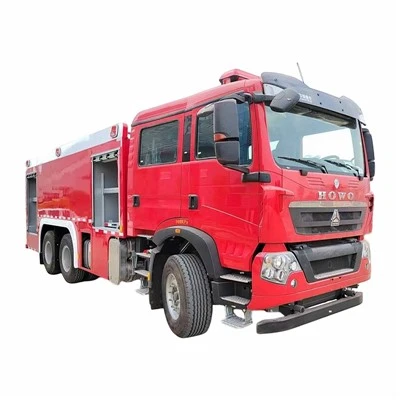
When we talk about large-scale oil fires, “large” isn’t just a small spill. A single fuel storage tank can hold 50,000 gallons or more, and a breach can create a fire that covers thousands of square feet. That’s why our lineup of heavy-duty foam fire trucks is built for exactly these scenarios. For example, the HOWO 25 Ton Heavy Foam Fire Truck is engineered to carry massive volumes of foam concentrate—enough to cover a large tank fire in minutes. But it’s not just about how much foam you have; it’s about how you mix it. The truck’s system automatically proportionates foam concentrate with water at the exact ratio needed (usually 3% for most hydrocarbon fuels, though this can adjust for special circumstances) to create a foam that’s thick enough to stick to the fuel surface.
Let’s walk through what happens on the scene when a foam fire truck responds to a large oil fire. First, the on-site team—firefighters, our technicians, and emergency response leaders—assesses the blaze. They need to know what type of fuel is burning, the size of the fire, and whether there are any nearby hazards like adjacent tanks or structures. This assessment determines which foam fire truck to deploy. For a smaller but still significant blaze, like a tanker truck fire, the HOWO 8 Ton Fire Truck Foam is ideal—it’s maneuverable enough to get close to the fire without endangering the crew, yet carries enough foam to cover the fuel slick. For larger incidents, like a refinery fire, we’ll call in the HOWO 16 Ton Foam Fire Truck or the bigger HOWO 25 Ton model.
Once the foam is ready, the truck’s pumping system sends the foam solution through hoses and monitors. But here’s the critical part for large fires: the foam has to be applied in a way that forms a continuous, thick blanket over the entire fuel surface. If you just spray foam randomly, it can break apart before it covers the fuel. The trucks we supply have adjustable monitors that can deliver foam in two forms: a low-expansion foam that’s perfect for large areas (it expands 10 to 20 times its liquid volume) or medium-expansion for more enclosed spaces. For a 10,000-square-foot fuel fire, you need a blanket that’s at least a foot thick to smother the flames—something a heavy foam truck can achieve in a single pass.
Another key step is cooling. Even after the foam blankets the fuel, the fire can re-ignite if the hot surface of the oil or the tank isn’t cooled down. That’s why many of our foam fire trucks, like the HOWO 18 Ton Foam Water Fire Truck, are designed to switch between foam and plain water mid-operation. After laying down the foam blanket, the crew can shift to water to cool the tank walls and surrounding area, preventing the fire from spreading. This dual-function capability is a game-changer for large-scale incidents where the risk of explosions from overheated tanks is high.
I’ve seen this work firsthand, not just as a supplier but in partnership with emergency teams during training exercises. Last year, we worked with a regional fire department to test the HOWO 25 Ton Heavy Foam Fire Truck at a simulated fuel tank fire. The fire was set to burn across 2,000 square feet, and the team deployed the truck within 10 minutes. The foam system mixed the concentrate with 5,000 gallons of water at the correct ratio, and the monitor sprayed a continuous blanket that covered the entire fire in under 8 minutes. Once the foam was down, they switched to water to cool the tank, and the fire was completely out in less than 15 minutes. Without the right foam truck, that fire could have spread to adjacent tanks, causing millions in damage and putting lives at risk.
But it’s not just about having a big truck—It’s about maintenance and training too. As a foam fire truck supplier, we don’t just sell vehicles; we provide training for the crews that use them and regular maintenance to keep the foam systems working. A foam fire truck’s pumps, proportioners, and foam tanks need to be checked regularly, because a malfunction mid-operation can be catastrophic during a large fire. For example, if the proportioner fails, the foam will be too weak to smother the fire, or too thick to spray properly. Our team works with departments to ensure their trucks are always ready, whether it’s a small Dongfeng 4 Ton Foam Fire Truck for urban tanker fires or a heavy HOWO model for industrial blazes.
Let’s talk about the science behind the foam itself. Most foam concentrates are made from water, a foaming agent, and a stabilizer that helps the foam stick to the fuel. For hydrocarbon fires (like gasoline or oil), we use aqueous film-forming foam (AFFF), which is a type of foam that forms a thin film on top of the fuel—this is what stops the fuel vapor from reaching the flames. For polar solvents (like alcohol-based fuels), we use a different type of foam, but most large-scale oil fires are hydrocarbon, so AFFF is the go-to. The foam expands when it’s sprayed, creating a layer that’s lighter than the fuel but heavy enough to stay on top, smothering the oxygen supply.
During a large fire, there’s also the issue of runoff. When foam is applied, some of it flows off the fuel surface into drains or onto the ground. This can be a problem if the foam enters water sources, but modern foam concentrates are biodegradable and non-toxic, so they don’t harm the environment. Our foam fire trucks are designed with built-in containment systems to capture excess foam runoff, preventing it from contaminating nearby areas. This is especially important for refineries, where water sources are often close to storage facilities.
Now, you might be wondering: why choose a specialized foam fire truck over a regular tanker? The difference is in the volume and the mix. A regular fire truck might carry 1,000 gallons of water and a small amount of foam concentrate, but it can’t sustain a foam application for a large fire. A heavy foam truck can carry 25,000 gallons of foam solution (concentrate plus water) and pump it at 1,500 gallons per minute—enough to keep a 1,000-square-foot fire covered continuously. That’s the kind of capacity you need for a large-scale oil fire that can burn for hours.


We’ve seen the impact our trucks have had in real incidents. A few months ago, a fuel tanker overturned on a highway, spilling 10,000 gallons of gasoline and catching fire. The local fire department had a HOWO 8 Ton Fire Truck Foam on standby, which arrived in 5 minutes. The crew deployed the foam within 3 minutes, smothering the fire before it could spread to nearby vehicles. Without that foam truck, the fire could have spread to a nearby gas station, causing a major disaster.
For industrial sites, like refineries or chemical plants, a single foam fire truck might not be enough—they need a fleet. Our range of foam fire trucks is designed to cover every scenario: small urban fires with the Dongfeng 4 Ton Foam Fire Truck, medium tanker fires with the HOWO 16 Ton Foam Fire Truck, and large refinery fires with the HOWO 25 Ton Heavy Foam Fire Truck. We also offer the HOWO 18 Ton Foam Water Fire Truck, which is perfect for sites that need both foam and water capability.
At the end of the day, handling a large-scale oil fire isn’t just about technology—it’s about preparation. As a foam fire truck supplier, we work with emergency teams to make sure they have the right equipment, the right training, and the right support to act fast. A foam fire truck isn’t just a vehicle; it’s a tool that can mean the difference between a small incident and a catastrophic disaster. If you’re in charge of emergency response for an urban area, a refinery, or a transportation hub, it’s worth investing in the right foam fire trucks to keep your community safe.
If you’re interested in learning more about our lineup of foam fire trucks, or discussing the best solution for your specific needs, we encourage you to reach out for a consultation. Whether you’re looking for a compact model for urban use or a heavy-duty truck for industrial sites, we can help you find the right fit. Our team is here to answer any questions, provide training resources, and ensure that your fleet is ready to respond when every second counts. Don’t wait until a fire happens—prepare today with the specialized equipment that can save lives and protect property.
References
- National Fire Protection Association. (2020). Standard for Foam Systems for Fire Protection (NFPA 11). Quincy, MA: Author.
- U.S. Fire Administration. (2018). Firefighting Foam for Hydrocarbon Fires: Best Practices for Deployment. Emmitsburg, MD: FEMA.
- Society of Fire Protection Engineers. (2019). Engineering Guide to Fire Fighting Foams. Bethesda, MD: Author.
- International Association of Fire Chiefs. (2021). Heavy-Duty Foam Fire Trucks for Large-Scale Industrial Incidents. Alexandria, VA: Author.
- Occupational Safety and Health Administration. (2020). Hazard Assessment for Fuel Storage Tank Fires. Washington, DC: U.S. Department of Labor.