

When someone calls for an ambulance, most people picture a screaming siren, a stretcher, and paramedics doing their best to keep a patient stable. But if you’ve ever ridden in one, you might’ve noticed that the air feels different—cooler, more consistent, almost sterile. As an ambulance supplier, I get asked all the time: “What kind of AC is actually in these things? It can’t just be a regular car AC, right?” You’re 100% correct. Ambulance AC isn’t just about keeping passengers comfortable. It’s a lifeline for patients, critical for equipment, and has to work even when the vehicle is idling, moving over bumpy roads, or sitting in extreme heat. Let me break this down, and throw in some examples from our lineup because that’s what we do.
First, let’s stop treating ambulance AC like regular HVAC. A standard car AC is built for 5-6 people, max, and can take breaks if the engine is idling—even then, it’ll get weak after a few minutes. Ambulances? They have two separate zones: the cab (for the driver and medic) and the patient compartment (where the stretcher, monitors, and ventilators live). The patient zone is non-negotiable for precise temperature control. COVID taught everyone how sensitive medical gear is—ventilators won’t work right if it’s 90 degrees inside the compartment, a patient with a fever needs a stable temp to keep from getting worse, and even meds for pain or allergies can break down if it’s too hot or cold.
That’s why most of our ambulances run on split-system AC units, not the single-unit stuff you see in passenger vans. A split system has two parts: a condenser under the hood (tied to the engine) and an evaporator in the patient compartment’s ceiling or walls. This lets us cool the patient zone without cranking the cab’s AC too, which is a win for the medic driving in heat or cold. But wait—what if the engine dies? Ambulances idle for ages when they’re at a scene, or stuck in traffic on the way to a hospital. Regular AC would cut out when the engine is off. That’s why we add auxiliary power units (APUs) to most models, especially ICU vans. The APU is a small, self-contained engine that powers the AC when the main engine’s off, or when we’re running critical gear like a cardiac monitor.
Let’s talk about different ambulance types because their AC needs shift. For example, our Toyota LHD First Aid Ambulance BLS Patient Transport Van is for basic life support—usually transporting patients who aren’t in super critical condition. Their AC is a mid-sized split system, enough to cool the small rear compartment without being too loud. We keep the noise low here because BLS patients might be anxious; a quiet AC doesn’t add to their stress. For ICU ambulances, though? We step it up. The Foton G9 Gasoline ICU Ambulance Van has a high-capacity split AC with dual evaporators in the patient compartment. Why dual? Because if a patient needs to be prepped for surgery mid-transport, we can adjust one evaporator to keep the patient cool while the other stays set to a cooler temp for the medical equipment. It’s not a gimmick—monitors like heart-lung machines generate heat, so if the AC can’t handle that, the gear will overheat and shut down.
Diesel ambulances, like our JMC Diesel Mobile ICU Ambulance Car, have another angle. Diesel engines are tougher for heavy-duty use, so their AC systems are built to handle extra load. We add a reinforced condenser that resists damage from rough roads—since diesel ambulances often go to rural areas with potholes or dirt roads. Plus, diesel burns less gas at idle than gasoline, so the APU can run longer without us worrying about the battery dying. That’s a big deal for paramedics who might spend 10 minutes stabilizing a patient at a crash scene—they don’t want the AC to cut out on them.
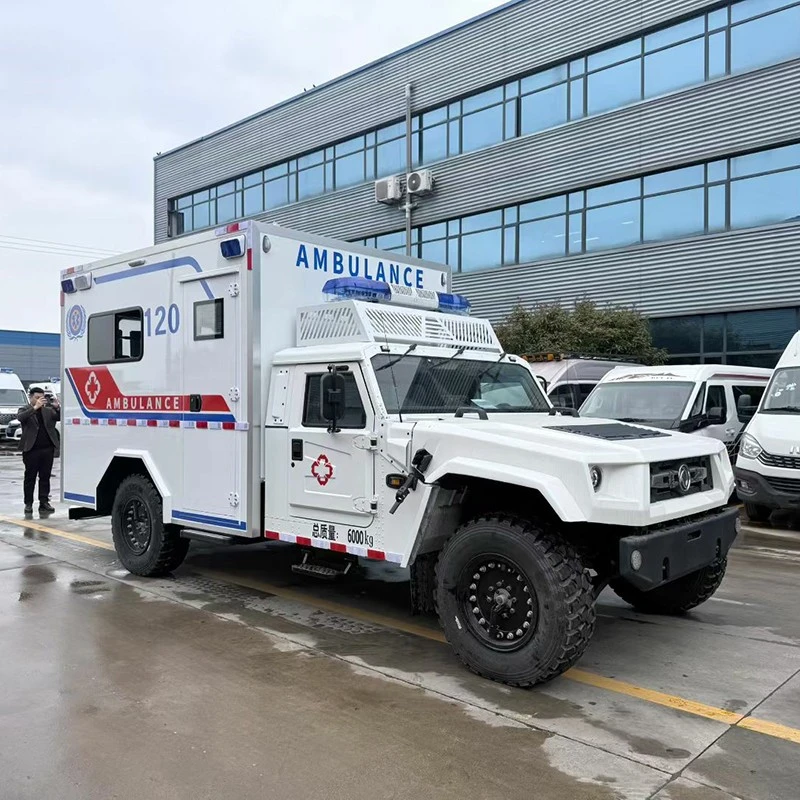
Now, off-road ambulances—those are wild. If you work in a mountain town, a rural area with no roads, or a disaster zone, you need an ambulance that can handle mud, rocks, and uneven terrain. Our Dongfeng 4x4 Chassis Off Road Ambulance and Iveco 4x4 Off Road Ambulance All Terrain ICU Vehicle have AC systems that are almost indestructible. The condenser is shielded with heavy steel mesh to keep branches or rocks from puncturing it. The evaporator is sealed tight to keep dust out—off-road areas have way more dirt than a city, and dust can clog the coils, making the AC stop working. We also add a higher-capacity compressor, because off-road driving is slow and stop-and-go, so the AC can’t rely on fast engine speed to cool it. It has to work at low RPM, same as the engine when you’re crawling over a hill.

Wait, another thing I don’t talk enough about: temperature stability. Patients in ambulances—especially trauma patients—can go into shock, which messes with their body temp. If the AC swings from 72 to 78 degrees in 10 minutes, that can make their shock worse. So all our systems have variable-speed fans and compressors, not just on/off. The APU adjusts how hard it runs based on the compartment temp, so it stays within half a degree of the set point. For critical patients, that’s the difference between a good outcome and a bad one.
I’ve seen this play out first-hand. A few years back, we sold an Iveco 4x4 to a search and rescue team in the Rockies. They had to rescue a hiker who’d been stuck in a snowstorm for two days, with a severe case of hypothermia. The off-road ambulance made it up the steep, icy trail, and once they got the hiker in, the AC kept the patient compartment at a steady 75 degrees—not too warm, not too cold. That’s exactly what the doctor ordered to get the hiker’s core temp back up safely. If they’d had a regular AC, it might’ve dropped too low when they hit a rough spot, or cut out when the engine idled on the way back down. That’s why we build these systems this way.
A lot of people also ask about air quality, not just temperature. Ambulance compartments can get weird smells—meds, cleaning supplies, even patients’ needs. So all our AC systems have built-in HEPA filters. The ones in ICU models have medical-grade HEPA filters that trap 99.97% of bacteria and viruses, which is huge for preventing cross-contamination. When we were ramping up for COVID, that filter upgrade was non-negotiable—we couldn’t have paramedics or patients getting sick from the air in the ambulance.
Now, let’s bust a common myth: all AC systems in ambulances are the same. Nope. A BLS transport van doesn’t need the same AC as a mobile ICU, which doesn’t need the same as an off-road rescue ambulance. Our Toyota LHD is made for city runs, so its AC is compact and efficient. The Foton G9, being an ICU van, has extra cooling capacity for gear. The off-road models are built to survive the environments where regular ambulances can’t go. That’s why we don’t sell one-size-fits-all—every customer’s needs are different, so their AC should match.
If you’re in the market for an ambulance, don’t sleep on the AC. It’s not just a comfort feature—it’s a medical device. A paramedic can have the best gear in the world, but if the AC is broken, the patient’s temp is off, or the equipment overheats, that gear is useless. That’s why our team spends hours testing each AC system in extreme temps—we do 100-degree heat tests in our warehouse in the summer, and 20-degree cold tests in winter, to make sure it works no matter what.
Whether you’re a fire department looking for a basic transport van, a hospital needing a mobile ICU, or a rescue team needing an off-road vehicle, we’ve got the right ambulance for you. Our lineup includes the Toyota LHD First Aid Ambulance BLS Patient Transport Van, Foton G9 Gasoline ICU Ambulance Van, JMC Diesel Mobile ICU Ambulance Car, plus our off-road options: Dongfeng 4x4 Chassis Off Road Ambulance and Iveco 4x4 Off Road Ambulance All Terrain ICU Vehicle. If you’re ready to chat about what works for your team, reach out to our sales team to walk through your needs and find the perfect ambulance with the right AC to keep patients safe.
References
- National Highway Traffic Safety Administration. (2021). Emergency Medical Services Ambulance Equipment Standards: HVAC Systems for Patient Compartments.
- Society of Emergency Medicine. (2022). Environmental Controls in Ambulances: Impact on Patient Stability and Medical Equipment Performance.
- International Organization for Standardization. (2020). ISO 14969:2020, Road vehicles — Ambulances — Requirements for heating, ventilation and air conditioning systems.
- Journal of Emergency Medical Services. (2021). Auxiliary Power Units and HVAC Reliability in Idling Ambulances: Field Test Data.