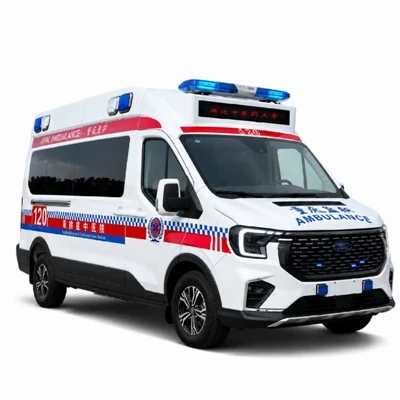


A BLS ambulance and an ICU ambulance may look similar from the outside, but they are designed for very different levels of patient care.
For hospitals, emergency medical service providers, government procurement agencies and ambulance fleet operators, choosing between the two should not begin with vehicle size or price.
It should begin with one question:
What level of care must the ambulance safely support while the vehicle is moving?
A Basic Life Support ambulance is generally designed for patients who require transportation, monitoring and basic emergency support but do not normally need continuous advanced critical-care intervention.
An ICU ambulance, by comparison, is designed for critically ill or unstable patients who may require advanced airway management, ventilation, cardiac monitoring, infusion therapy and other forms of continuous medical support during transportation.
The difference affects far more than the medical equipment list.
It also changes the requirements for:
Interior working space
Oxygen capacity
Electrical power
Battery backup
Equipment mounting
Medical staff seating
HVAC
Payload
Storage
Vehicle chassis
Maintenance
Procurement cost
This guide explains the practical differences between a BLS ambulance and ICU ambulance, and what professional buyers should evaluate before specifying either vehicle.
1. What Is a BLS Ambulance?
A BLS ambulance, or Basic Life Support ambulance, is designed to provide essential pre-hospital care and safe patient transportation.
Typical BLS missions may include:
Non-critical emergency response
Patient stabilization
Inter-facility transfer of stable patients
Basic oxygen support
Immobilization
First aid
Wound management
Basic monitoring
Transport of patients who do not require intensive-care treatment
The exact definition of BLS varies by country, EMS system and medical regulation.
In some markets, the vehicle may be operated primarily for emergency response. In others, the same category may also be used for hospital transfers and community medical transportation.
For that reason, a buyer should never assume that one universal BLS equipment list applies worldwide.
The ambulance should be configured around the clinical protocols and regulatory requirements of the destination market.
2. What Is an ICU Ambulance?
An ICU ambulance, often called an Intensive Care Ambulance or Critical Care Ambulance, is designed to transport patients who may require advanced and continuous medical treatment during transit.
These vehicles can function as a compact mobile critical-care environment.
Typical applications may include:
Transport of critically ill patients
Inter-hospital ICU transfer
Ventilator-dependent patient transport
Advanced cardiac monitoring
Post-operative critical-care transfer
Severe trauma transport
High-risk neurological or cardiac patients
Long-distance critical-care transportation
Transfer between hospitals with different levels of care
Depending on local standards and clinical requirements, an ICU ambulance may carry equipment such as:
Transport ventilator
Multiparameter patient monitor
Defibrillator
Infusion pumps
Syringe pumps
Advanced suction equipment
Multiple oxygen cylinders
Airway-management equipment
Emergency medication storage
Additional electrical backup
An ICU ambulance therefore requires more engineering integration than simply installing additional medical devices inside a normal ambulance.
3. BLS Ambulance vs ICU Ambulance: Quick Comparison
| Item | BLS Ambulance | ICU Ambulance |
|---|---|---|
| Primary Mission | Basic emergency care and patient transport | Critical-care patient transport |
| Patient Condition | Generally stable or moderately ill/injured | Critically ill or unstable |
| Medical Capability | Basic life support | Advanced/critical-care support |
| Ventilator | Usually optional / project dependent | Commonly required |
| Multiparameter Monitor | Basic or optional depending on specification | Commonly required |
| Defibrillator | Depends on local BLS protocol | Commonly included |
| Infusion Pumps | Limited or optional | Often multiple units |
| Oxygen Demand | Moderate | Higher |
| Electrical Load | Moderate | Significantly higher |
| Equipment Storage | Standard | More extensive |
| Medical Cabin Space | Moderate | Greater working space preferred |
| Auxiliary Battery Requirement | Moderate | Higher |
| Vehicle Payload | Lower medical equipment load | Higher equipment load |
| Procurement Cost | Generally lower | Generally higher |
| Maintenance Complexity | Lower | Higher |
| Typical Application | EMS, transport, basic emergency support | ICU transfer and critical care |
This table is a useful starting point, but it does not replace a detailed technical specification.
Two ambulances carrying the same label can still have very different capabilities.
4. The Biggest Difference Is the Patient's Clinical Condition
The most important distinction between a basic life support ambulance and an ICU ambulance is not the vehicle.
It is the patient.
A BLS vehicle is typically appropriate when the patient can be transported without continuous advanced life-support intervention.
An ICU vehicle becomes more appropriate when the patient's condition may require:
Mechanical ventilation
Continuous ECG monitoring
Frequent blood-pressure monitoring
Oxygen at higher flow rates
Multiple drug infusions
Defibrillation capability
Advanced airway support
Continuous medical intervention during transportation
This is why professional ambulance procurement should begin with the expected patient profile.
Do not first ask:
"Which ambulance model is cheaper?"
Ask:
"What could happen to the patient during the journey, and what must the medical team be able to do if the condition deteriorates?"
That question leads to a far better vehicle specification.
5. Medical Equipment: BLS and ICU Requirements Are Not the Same
Medical equipment is one of the most visible differences between the two ambulance types.
Typical BLS Ambulance Equipment
Depending on the project, a BLS ambulance may include:
Main stretcher
Scoop stretcher
Spine board
Folding stretcher
Oxygen cylinder
Oxygen regulator
Oxygen outlet
Portable suction unit
First-aid kit
Trauma kit
Blood-pressure equipment
Basic diagnostic equipment
IV hooks
Medical cabinets
Attendant seat
Fire extinguisher
Emergency lights and siren
Some BLS systems may also include AED or additional monitoring equipment depending on local protocol.
Typical ICU Ambulance Equipment
An ICU ambulance may require:
Main stretcher
Transport ventilator
Multiparameter patient monitor
Defibrillator
Advanced suction equipment
Infusion pumps
Syringe pumps
Multiple oxygen cylinders
Oxygen distribution system
Advanced airway equipment
IV rail or infusion mounting system
Emergency medications
Additional medical storage
Medical refrigerator if required
Higher-capacity electrical system
Additional backup power
The important purchasing principle is this:
Equipment should follow the clinical mission, not a marketing checklist.
Installing more devices does not automatically create a better ambulance.
If the equipment cannot be safely mounted, powered, maintained and accessed while the vehicle is moving, it may actually reduce operational effectiveness.
6. ICU Ambulances Need More Working Space
One of the most common specification mistakes is trying to install ICU-level equipment into a medical cabin originally designed for basic patient transportation.
A critical-care team may need access to:
The patient's airway
Monitor
Ventilator
Infusion pumps
Oxygen controls
Suction
Emergency medication
Electrical outlets
at the same time.

This changes the interior design.
A good ICU medical cabin should consider:
Stretcher position
Head-end access
Doctor or paramedic seating
Assistant seating
Equipment visibility
Emergency equipment access
Cable routing
IV line routing
Safe movement while the ambulance is in motion
A larger medical cabin can help, but layout quality is more important than vehicle length alone.
Poorly positioned equipment can make a large ambulance difficult to work in.
7. Why Head-End Access Matters More in an ICU Ambulance
In a basic transport ambulance, medical staff may mainly observe the patient from the side.
In critical-care transport, the medical team may need frequent access to the patient's airway and ventilation equipment.
That makes the area around the head of the stretcher particularly important.
The design should avoid placing fixed cabinets or structural components where they restrict airway-management access.
Ventilator tubing, monitor cables and oxygen connections should also be arranged to reduce:
Tangling
accidental disconnection
obstruction of staff movement
damage during loading and unloading
For an ICU ambulance, these small layout decisions can be more important than decorative interior features.
8. Oxygen Capacity Is a Major Difference
Both BLS and ICU ambulances may carry medical oxygen.
But the required capacity can be very different.
A BLS ambulance may mainly use oxygen for:
Short-term supplemental oxygen
Basic respiratory support
Routine patient transportation
An ICU ambulance may support a patient using mechanical ventilation continuously during a long inter-hospital transfer.
This can significantly increase oxygen consumption.
Professional ICU ambulance planning should therefore consider:
Cylinder quantity
Cylinder capacity
Expected oxygen flow
Ventilator consumption
Journey duration
Emergency reserve
Cylinder replacement procedure
Secure cylinder mounting
Pressure regulation
The key question is not simply:
"How many oxygen cylinders are installed?"
It is:
"How long can the onboard oxygen supply support the expected patient under realistic operating conditions?"
That is a much more useful engineering question.
9. Electrical Power Is Much More Critical in an ICU Ambulance
A BLS ambulance normally has a moderate electrical load.
An ICU ambulance may need to power several critical devices simultaneously.
These may include:
Ventilator
Patient monitor
Defibrillator
Infusion pumps
Syringe pumps
Suction equipment
Medical refrigerator
Medical lighting
Air conditioning
Communication equipment
Charging equipment
The electrical system therefore needs to be designed as a complete power network.
Important components may include:
Chassis alternator
Auxiliary battery bank
Battery isolator
Battery management system
DC distribution
Inverter
AC outlets
DC outlets
Shore-power connection
Circuit protection
Charging system
For critical-care transport, power redundancy becomes more important because a medical device failure can directly affect patient care.
10. Why Battery Backup Needs to Be Calculated
A common mistake is specifying the auxiliary battery only by amp-hour capacity.
That number alone is not enough.
The manufacturer needs to understand:
Total connected load
Continuous power demand
Peak load
Device voltage
inverter efficiency
expected stationary operating time
alternator charging capacity
Consider an ambulance waiting outside a hospital with the engine off.
The medical equipment, lighting and HVAC may continue consuming power.
If the electrical system was designed only for short-duration operation, battery voltage can fall rapidly.
For an ICU ambulance, electrical autonomy should therefore be evaluated under realistic operating conditions.
11. Equipment Mounting Is a Safety Issue
A ventilator or monitor may be relatively small, but during emergency braking it effectively becomes a moving mass.
Medical equipment should not simply be placed on shelves.
Professional ambulance design should use suitable mounting systems for:
Ventilators
Monitors
Defibrillators
Infusion pumps
Oxygen cylinders
Suction equipment
Portable devices
The mounting design should also allow the equipment to remain accessible.
There is little value in securing a device so tightly that medical staff cannot remove or operate it quickly during an emergency.
This balance between:
secure fixation + rapid clinical access
is especially important in ICU vehicles.
12. BLS Ambulance Interior Design Should Remain Practical
BLS ambulances usually carry less medical equipment than ICU vehicles, but that does not mean layout is unimportant.
In fact, a simpler ambulance can still perform poorly if:
The stretcher blocks cabinet access
The attendant cannot sit near the patient
Oxygen controls are difficult to reach
The aisle is too narrow
Medical supplies are scattered across multiple cabinets
The rear loading area is poorly designed
A strong BLS design should prioritize:
simplicity, accessibility, easy cleaning and repeatable daily operation.

For municipal EMS fleets with many vehicles, a standardized interior can also simplify staff training.
13. HVAC Requirements Can Be Higher in an ICU Ambulance
Temperature control affects both patients and medical equipment.
Critically ill patients may spend long periods inside the ambulance during transfers.
At the same time, medical staff, lighting and electronic devices generate heat.
This makes climate control especially important.
The HVAC system should be evaluated based on:
Destination climate
Medical cabin volume
Patient load
Number of medical personnel
Insulation
Vehicle operating time
Whether the engine remains running
Heat generated by equipment
An ambulance operating in the Middle East may require a very different cooling strategy from one operating in a cold European climate.
Climate should therefore be part of the original vehicle specification.
14. Payload Becomes More Important as Medical Capability Increases
ICU equipment adds weight.
The final ambulance payload may include:
Stretcher
Medical staff
Patient
Oxygen cylinders
Ventilator
Monitor
Defibrillator
Infusion equipment
Batteries
inverter
Medical cabinets
HVAC
Consumables
Additional electronics
This is why an ICU ambulance may require a higher-capacity chassis than a basic BLS configuration.
A vehicle that looks spacious can still have insufficient legal payload.
Professional buyers should therefore ask for:
Chassis GVW
Curb weight after conversion
Available payload
Front axle load
Rear axle load
Completed-vehicle weight distribution
Body size alone should never determine ambulance capability.
15. Which Chassis Is Better for a BLS Ambulance?
A BLS ambulance often works well on a medium or full-size commercial van platform.
Typical priorities include:
Easy urban driving
Good fuel economy
Sufficient interior height
Easy stretcher loading
Local service availability
Spare-parts supply
Reasonable acquisition cost
For urban EMS and hospital transport, excessive vehicle size can increase:
Fuel consumption
turning radius
parking difficulty
maintenance cost
A correctly sized van may therefore be more practical than a larger truck.
16. Which Chassis Is Better for an ICU Ambulance?
There is no single ideal ICU ambulance chassis.
The correct platform depends on how much equipment and working space the project requires.
Possible choices include:
High-roof van
Extra-long van
Light-duty truck chassis
Purpose-built box-body ambulance
The chassis should provide sufficient:
Payload
medical cabin dimensions
electrical capacity
HVAC capability
ride comfort
service support
A truck-based ICU ambulance may provide more space, but it can also introduce higher operating cost and reduced maneuverability.
The best solution depends on the clinical mission.
17. Ride Comfort Matters for Both Ambulance Types
Suspension is sometimes overlooked during ambulance procurement.
But patients experience every acceleration, braking event and road impact through the stretcher.
Ride quality is particularly important for:
Trauma patients
Post-operative patients
spinal injuries
critically ill patients
long-distance transport
Buyers should consider:
Suspension design
Tire specification
vehicle wheelbase
stretcher mounting
axle load
road conditions
For long-distance ICU transfer, ride comfort can be especially important because treatment continues while the vehicle is moving.
18. Infection Control Applies to Both BLS and ICU Ambulances
Both ambulance types need interior surfaces that support cleaning and disinfection.
Good medical cabin design may include:
Smooth wall panels
Sealed flooring
Rounded cabinet edges
Washable surfaces
Easy-to-clean seats
Reduced dirt-trapping gaps
Accessible corners
An ICU ambulance generally contains more equipment and cables, which can create more surfaces that require cleaning.
This makes organized equipment mounting even more important.
The interior should not only look clean when delivered.
It should remain practical to clean after hundreds or thousands of patient transports.
19. BLS Ambulance vs ICU Ambulance: Maintenance Difference
A BLS ambulance typically has fewer complex medical and electrical systems.
Maintenance may focus on:
Vehicle chassis
stretcher
oxygen system
lighting
suction unit
warning system
air conditioning
An ICU ambulance adds more systems that may require scheduled inspection or calibration:
Ventilator
patient monitor
defibrillator
infusion pumps
larger battery system
inverter
charging system
medical electrical circuits
Fleet operators should therefore consider long-term technical support before selecting advanced equipment brands.
A sophisticated device can become difficult to maintain if replacement parts or authorized service are unavailable locally.
20. Why ICU Ambulances Cost More
Buyers comparing ambulances for sale often notice a significant price difference between BLS and ICU configurations.
The reason is not only the medical devices.
An ICU ambulance may require upgrades to:
Chassis capacity
interior structure
medical cabinets
oxygen system
electrical system
battery capacity
inverter capacity
HVAC
equipment mounts
wiring
power outlets
technical integration
Therefore, converting a BLS ambulance into an ICU ambulance is not always as simple as adding a ventilator and monitor later.
If ICU capability may be needed, it should be considered during the original engineering stage.
21. Can a BLS Ambulance Be Upgraded to an ICU Ambulance Later?
Sometimes, but not always economically.
Before upgrading, the operator needs to verify whether the original vehicle can support:
Additional equipment weight
Greater electrical load
Larger oxygen capacity
More medical staff
Additional storage
Ventilator installation
More complex patient monitoring
If the original BLS vehicle has limited payload or electrical reserve, conversion may require extensive modification.
In some cases, purchasing a purpose-designed ICU ambulance may be safer and more cost-effective.
This is another reason fleet buyers should consider future clinical requirements during the original procurement stage.
22. Which Ambulance Is Better for Inter-Hospital Transfer?
It depends on the patient's condition.
A stable patient who does not require advanced life support may be safely transported in an appropriately equipped BLS ambulance, depending on local medical protocol.
A critically ill patient requiring:
Ventilation
Continuous monitoring
infusion therapy
advanced airway support
potential emergency intervention
is more likely to require an ICU or critical-care ambulance.
The correct decision should be made by the responsible medical organization according to the patient's clinical needs and local regulations.
The vehicle category should follow the care requirement.
23. Which Ambulance Should Government and Hospital Buyers Choose?
For many fleets, the correct answer is not to purchase only one type.
A balanced EMS fleet may include:
Patient transport ambulances
BLS ambulances
ICU ambulances
4x4 ambulances
specialized emergency vehicles
Why?
Because using an ICU ambulance for every low-acuity transport can increase:
equipment utilization
fuel cost
maintenance workload
staffing requirements
capital cost
At the same time, using an under-equipped vehicle for a critically ill patient can create obvious clinical limitations.
The goal should therefore be:
match vehicle capability to mission severity.
This improves fleet utilization and helps ensure the most capable vehicles remain available when they are genuinely required.
24. What Information Should You Give an Ambulance Manufacturer?
Before requesting a quotation, provide detailed operational information.
A professional inquiry should include:
Destination country
Required quantity
BLS or ICU application
Main patient profile
Preferred chassis
Left-hand or right-hand drive
4x2 or 4x4 requirement
Emission standard
Required stretcher system
Oxygen requirement
Ventilator requirement
Monitor and defibrillator requirement
Infusion-pump requirement
Electrical equipment list
Required HVAC performance
Local climate
Required certifications
Spare-parts requirement
Operator training requirement
Delivery schedule
A detailed inquiry allows the ambulance manufacturer to engineer the vehicle around the actual medical mission rather than sending a generic quotation.
25. What Should Buyers Compare Between Two Ambulance Quotations?
Do not compare only the total price.
Compare the technical specification line by line.
| Item | Why It Matters |
|---|---|
| Chassis GVW | Determines payload capacity |
| Finished Vehicle Weight | Shows remaining operational payload |
| Medical Cabin Size | Affects treatment space |
| Stretcher System | Affects patient loading and safety |
| Oxygen Capacity | Determines available respiratory support |
| Electrical System | Supports critical medical equipment |
| Auxiliary Battery | Determines backup operating time |
| Inverter Capacity | Supports AC medical devices |
| HVAC | Maintains patient and staff environment |
| Equipment Mounting | Protects staff and devices |
| Medical Equipment Brands | Affects performance and future service |
| Spare Parts | Reduces future downtime |
| Documentation | Supports maintenance and operation |
| Warranty | Important for fleet management |
The lowest initial quotation may not provide the lowest total cost of ownership.
26. BLS vs ICU Ambulance Buying Checklist
Before confirming the order, check:
Clinical mission has been defined
Patient condition has been considered
BLS or ICU capability has been confirmed
Destination-country requirements are understood
Chassis payload is sufficient
Stretcher system is confirmed
Interior layout has been approved
Oxygen consumption has been evaluated
Medical equipment list is finalized
Electrical load is calculated
Auxiliary battery capacity is confirmed
HVAC suits the destination climate
Equipment mounting is approved
LHD or RHD is confirmed
Emission standard is confirmed
Spare parts are available
Maintenance documentation is included
Pre-delivery inspection is planned
The earlier these points are confirmed, the fewer expensive changes are required later in production.
FAQ
What is the main difference between a BLS ambulance and an ICU ambulance?
A BLS ambulance is generally designed for basic emergency support and transportation of patients who do not require continuous advanced critical-care treatment. An ICU ambulance is designed for critically ill patients who may require ventilation, continuous monitoring, infusion therapy and other advanced medical support during transport.
What equipment is normally installed in a BLS ambulance?
Typical equipment may include a stretcher, oxygen system, suction unit, spine board, first-aid equipment, medical cabinets, attendant seating and emergency warning systems. Exact equipment depends on local EMS requirements.
What equipment is normally installed in an ICU ambulance?
An ICU ambulance may include a transport ventilator, multiparameter monitor, defibrillator, infusion pumps, syringe pumps, advanced suction, a higher-capacity oxygen system and more extensive electrical backup.
Does every ICU ambulance need a ventilator?
Ventilators are commonly associated with critical-care transport, but the exact mandatory equipment depends on the clinical mission and local regulations. Buyers should specify the intended patient type before finalizing the equipment list.
Is an ICU ambulance larger than a BLS ambulance?
Not always. Both may use similar van platforms. However, ICU ambulances often benefit from more working space because they carry more equipment and may need additional medical personnel.
Can a BLS ambulance be converted into an ICU ambulance?
It may be possible if the chassis payload, electrical system, oxygen capacity and medical cabin space can support the additional equipment. However, extensive upgrades may make a purpose-built ICU ambulance more practical.
Which ambulance is better for hospital-to-hospital transfer?
The patient's clinical condition determines the appropriate vehicle. Stable patients may be transported in a suitable BLS vehicle, while critically ill patients who require advanced monitoring or treatment may need an ICU ambulance.
Why is an ICU ambulance more expensive?
An ICU ambulance typically requires more medical equipment, greater oxygen capacity, a higher-capacity electrical system, additional batteries, specialized equipment mounting and more complex interior engineering.
Final Thoughts
The difference between a BLS ambulance and ICU ambulance is ultimately a difference in clinical capability.
A BLS ambulance focuses on reliable basic emergency support, safe patient transportation and practical daily operation.
An ICU ambulance must support a much more demanding medical environment, where critically ill patients may depend on ventilation, continuous monitoring, oxygen, infusion therapy and uninterrupted electrical power during transportation.
For professional buyers, the correct approach is not to ask which ambulance has the longest equipment list.
Instead, evaluate the complete system:
Patient condition → Medical mission → Chassis → Interior layout → Oxygen → Electrical power → Medical equipment → Payload → Maintenance
When these elements are correctly matched, the result is an ambulance that is not only well equipped, but actually suitable for its intended clinical mission.
For hospitals, governments and EMS organizations building a larger fleet, combining BLS ambulances with ICU ambulances can also provide better resource allocation-using basic-life-support vehicles for appropriate missions while reserving critical-care vehicles for patients who genuinely require advanced medical support.