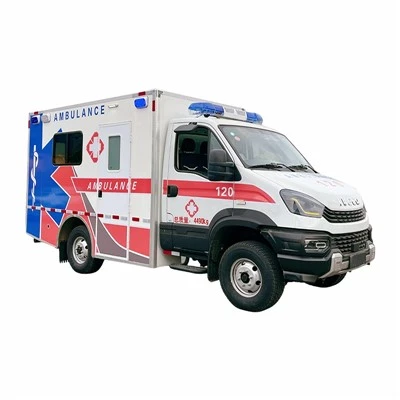


If you’ve ever stood on a dusty, rutted road in a remote village where paved asphalt ends and the only way in is via a trail that twists through rocky hills or flood-prone valleys, you know the difference a good off-road ambulance makes. For years, as an off-road ambulance supplier, I’ve heard stories from medics and aid workers: the one that reached a patient stuck in a mudslide when a regular ambulance would have turned back, the one that navigated a snow-laden mountain pass during a blizzard that grounded helicopters, the one that became a lifeline when every other route was cut off. Off-road ambulances are engineered for the worst terrain on Earth, designed to bridge gaps that standard emergency vehicles can’t touch—so it’s easy to assume they’re a perfect solution for pre-hospital care in harsh, underserved areas. But if you spend as much time talking to the people who use these vehicles every day as I do, you learn quickly that off-road ambulances have serious, often underdiscussed limitations that can make them more of a liability than a lifeline if you don’t plan for them properly.
Let me start with the most obvious limitation, but one that surprises a lot of first-time buyers: the tradeoff between off-road capability and on-road performance, especially when it comes to speed. Standard ambulances built for cities are optimized to cruise at 60 or 70 miles per hour on smooth highways, with engines tuned for consistent, fast acceleration and smooth handling. Off-road models? They’re built for low-end torque, heavy-duty suspension, and high ground clearance—all of which make them sluggish on paved roads. A 4x4 off-road ambulance can take twice as long to reach a hospital when the terrain is actually passable, and in emergency care, every minute matters. I once worked with a medical team in a mountainous region of Nepal that tested three different off-road ambulance models, including a Dongfeng 4x4 Chassis Off Road Ambulance from our line, for a 45-mile trip between a remote clinic and the nearest tertiary hospital. On good days, the trip took 1 hour and 20 minutes in a standard road ambulance, but the off-road model took 1 hour and 50 minutes on the same paved section. When you’re transporting a patient with a severe trauma, a stroke, or an acute cardiac event, that extra half hour can be the difference between survival and permanent disability. It’s not that off-road ambulances are slow on bad terrain—they’re faster than any other vehicle there—but when the road is even slightly passable, their off-road tuning becomes a drawback.
Next, there’s the issue of payload and interior space, which is non-negotiable for emergency care. Off-road chassis are heavier than standard ones, built with reinforced frames and heavy-duty components to handle rocks, mud, and steep grades. That extra weight eats into how much you can carry inside the ambulance. Let’s break it down: a standard road ambulance has a spacious interior that fits a full-size stretcher, a crash cart, a ventilator, a defibrillator, IV stands, oxygen tanks, and room for two medics and a patient. Many off-road models, especially smaller ones built on pickup chassis, sacrifice interior space for ground clearance. Take a model like our Isuzu 4x4 Off Road Pickup Ambulance—it’s a fantastic option for narrow village trails and mountain paths that full-size trucks can’t navigate, but its compact frame means the interior is tighter. There’s barely enough room for a full-size adult stretcher, and some medical equipment has to be left behind because there’s no space for it. In contrast, larger off-road models like the IVECO 4x4 Off-Road Ambulance Truck have more interior space, but their heavier chassis means they have a lower payload capacity for medical supplies. I’ve heard stories from medics in the Sahel region who had to leave a second oxygen tank behind during a transfer because the ambulance was already carrying enough weight to navigate a sandy stretch of road. If a patient’s condition deteriorates en route, that missing supply can be life-threatening. Even the most advanced off-road ICU vehicles, like our Iveco 4x4 Off Road Ambulance All Terrain ICU Vehicle, designed for critical care in remote areas, still have to make compromises—they can fit a ventilator, but some of the more advanced life support monitors used in urban ICUs have to be modified to fit in the narrower interior, leading to occasional reliability issues.
Then there’s maintenance and repair, which is a huge barrier in remote areas. Off-road ambulances are built with heavy-duty parts, but those parts are not always readily available in the same places where you need them. A standard road ambulance has parts that are common across most auto shops, even in small towns. But a 4x4 off-road ambulance requires specialized components: heavy-duty suspension parts, locking differentials, reinforced transmission parts, and the chassis-specific electronics that let the four-wheel drive system engage. If you’re working in a region with no paved roads, no dedicated mechanics, and no parts warehouses within a 500-mile radius, a minor issue can turn your ambulance into a useless hunk of metal. Let’s say a front suspension component fails during a rescue mission in the Andes. A standard ambulance’s suspension part can be ordered and flown in to a nearby clinic within a day, but an off-road-specific suspension part might take a week or more to source, if it’s even available at all. I once had a customer in a rural part of Kenya whose off-road ambulance broke down with a faulty transfer case during a drought relief mission. The nearest replacement part was in Mombasa, 300 miles away, and it took two weeks to transport it over dirt roads. In that time, the team had to use a modified pickup truck as an ad-hoc ambulance, which couldn’t carry the level of medical equipment their patients needed. Even routine maintenance is harder: off-road ambulances need more frequent oil changes, differential flushes, and tire replacements because they’re operating in harsh conditions. In remote areas where fuel is scarce and mechanics are few, sticking to that maintenance schedule is often impossible, leading to more breakdowns over time.
Fuel efficiency is another underrated limitation, especially in regions where fuel is expensive or hard to access. Off-road ambulances are not known for being fuel-sipping. Their heavy engines and four-wheel drive systems guzzle fuel, often getting 8 to 12 miles per gallon on paved roads, and 4 to 6 miles per gallon off-road. Compare that to a standard road ambulance, which gets around 15 to 18 miles per gallon, and the difference is stark. For medics operating in remote areas where fuel has to be transported in jerry cans over long distances, the cost of keeping an off-road ambulance running adds up quickly. A single 45-mile trip in the off-road ambulance we tested in Nepal used twice as much fuel as the standard road ambulance, and over the course of a month, that extra fuel cost thousands of dollars that could have been used for medical supplies, staff training, or more ambulances. In conflict zones or disaster areas where fuel is rationed, that inefficiency can mean the difference between being able to respond to calls and having to wait for fuel that never comes. I’ve worked with several aid organizations that opted for smaller off-road ambulances to save on fuel, but those smaller models often can’t carry enough patients or equipment to meet their needs.
There’s also the issue of crew training and usability, which is often overlooked when buying an off-road ambulance. Driving an off-road ambulance is not the same as driving a regular vehicle. It requires specialized training to handle four-wheel drive, navigate uneven terrain, adjust for the vehicle’s larger size on narrow trails, and respond to emergency situations while operating off-road. A medic or driver who is used to driving urban ambulances might not know how to engage the locking differential when they hit a muddy patch, or how to adjust the suspension to handle a steep hill, leading to avoidable breakdowns or accidents. Even beyond driving, operating the medical equipment in an off-road ambulance is different. The constant jostling and vibration of rough terrain can cause equipment to malfunction, and medics have to be trained to secure stretchers, monitors, and oxygen tanks to prevent them from shifting during transport. In many low-resource areas, there’s a shortage of both trained drivers and trained medics, so trying to use an off-road ambulance without that specialized knowledge is a recipe for errors. I once saw a situation where a rural clinic in Peru bought an off-road ambulance but had to assign a general clinic driver to it, who had no experience driving off-road. The driver hit a rock that damaged the chassis, and the ambulance was out of service for three months while parts were ordered.
Last, but definitely not least, is the environmental limitation of extreme terrains. Even the best off-road ambulance can’t handle every type of harsh environment. There are situations where no four-wheel drive, no ground clearance, no heavy-duty suspension will help. For example, in areas with deep, loose sand dunes—like parts of the Sahara or the Arabian Desert—off-road ambulances can get stuck easily if they don’t have specialized sand tires and traction control, which aren’t standard on most models. In areas with deep mud or quicksand, even a 4x4 ambulance can sink if the ground is unstable. I’ve heard stories of off-road ambulances that got stuck in floodwaters during monsoon season in Bangladesh, requiring rescue teams to use boats to pull them out, which delayed patient care. In high-altitude regions above 10,000 feet, the thin air can cause off-road ambulance engines to lose power, making it harder to climb steep grades or navigate rocky paths. Even in areas with heavy snow and ice, most standard off-road ambulances aren’t equipped with snow tires, chains, or heated engines that can operate in temperatures below -20 degrees Fahrenheit—something that’s necessary for mountainous regions in places like Canada, Greenland, or the Himalayas.


Now, before you think I’m bashing off-road ambulances entirely—they are still one of the most important tools for emergency care in remote, underserved areas. I’ve seen them save countless lives when every other option is gone, and that’s why I’ve made it my work to provide high-quality, reliable models like the ones we offer: Dongfeng 4x4 Chassis Off Road Ambulance, IVECO 4x4 Off-Road Ambulance Truck, Isuzu 4x4 Off Road Pickup Ambulance, and the advanced Iveco 4x4 Off Road Ambulance All Terrain ICU Vehicle. But the key word here is “careful planning.” The limitations I’ve outlined aren’t reasons to avoid off-road ambulances—they’re reasons to make sure you choose the right model for your specific needs, budget, and operating environment, and to invest in the maintenance, training, and support systems you need to keep them running.
If you’re an aid organization, a government health agency, or a medical provider operating in a remote area, the last thing you want is an ambulance that looks great on paper but can’t deliver when it matters. That means talking to someone who knows the terrain, the budget, and the day-to-day realities of using these vehicles. It means not just looking at specs like ground clearance and four-wheel drive, but also asking about fuel efficiency, parts availability, interior space for medical equipment, and the training your team will need. It means planning for maintenance schedules, having a backup for when parts break, and making sure you have the support network to keep your ambulance operational.
At the end of the day, off-road ambulances solve a critical problem: they bring life-saving care to people who would otherwise have no access to it. But like any piece of medical equipment, they have their limits. The more you understand those limits, the better you can prepare for them, and the more effective your ambulance will be when you need it most. If you’re looking to equip your remote health program with an off-road ambulance, I’m here to help you navigate the options, answer your questions, and find a solution that works for your community. Reach out to our team to start the conversation about your needs, your terrain, and how we can support your emergency care goals.
References
- World Health Organization. (2021). Global Status Report on Ambulance Services for Emergency Medical Care. Geneva: World Health Organization.
- Médecins Sans Frontières. (2022). Off-Road Ambulance Operations in Remote and Underserved Regions. Amsterdam: Médecins Sans Frontières Operational Center.
- International Organization for Standardization. (2019). ISO 10140:2019: Ambulances – Requirements and Test Methods for Off-Road Capability. Geneva: International Organization for Standardization.
- United Nations Office for the Coordination of Humanitarian Affairs. (2020). Logistics in Remote Humanitarian Settings: Best Practices for Ambulance Maintenance and Operations. New York: United Nations.