
Introduction
A mobile operating room works by recreating a controlled surgical environment inside a transportable platform. The vehicle provides structure and mobility, but safe operation depends on several systems acting together: clinical zoning, airflow, electrical power, medical gases, water, communications, equipment restraint and a repeatable deployment process.
The design challenge is that the unit changes state. It travels as a vehicle, deploys as a clinical workspace, supports procedures and then must be cleaned, restocked and made ready to move again. Every cable, pipe, cabinet and piece of equipment must therefore work both in transit and in service.
1. The Unit Operates in Four Distinct States
First is transit. Equipment is locked, cylinders are restrained, liquids are controlled, access steps are stowed and the body remains within the legal transport envelope. Second is setup, when the vehicle is levelled, external utilities are connected, slide-outs or awnings are deployed and system checks begin.
Third is clinical operation. Doors, airflow, power, gas supply, staffing and material movement follow an approved workflow. Fourth is turnaround: waste leaves, surfaces are cleaned, supplies are replaced, instruments follow the selected reprocessing route and systems are checked before the next case or journey.
Designing for only the clinical state creates common problems. A monitor may be convenient during surgery but poorly secured in transit. A large step may work on a level factory floor but be unsafe on an uneven deployment site. The operating concept must cover the entire cycle.
2. Functional Zones Support the Surgical Pathway
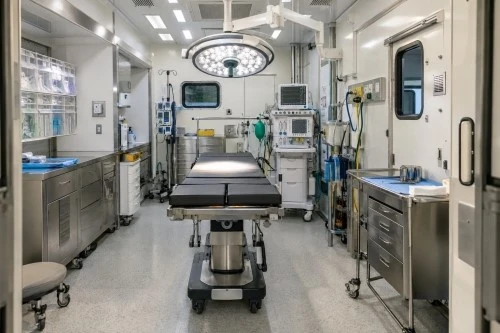
Depending on body size and clinical scope, the unit may include changing or preparation space, scrub facilities, an operating room, storage and limited recovery. Zoning is not simply a row of rooms. It controls what enters the operating area, where staff prepare and how clean supplies remain protected.
Space around the operating table is organized by task. The anaesthesia zone needs access to the airway, gases, suction, monitoring and power. The surgical team needs lighting, instrument access and freedom from door swings. Circulating staff need routes to storage and waste without repeatedly crossing the sterile field.
The best layout is tested with the actual team and representative equipment. Tape on a floor, a digital human model or a physical mock-up can expose conflicts before the body is built.
3. HVAC Creates a Controlled Air Environment
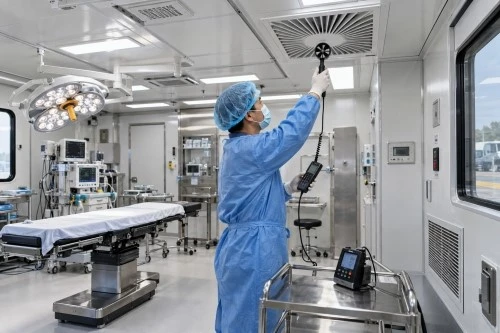
The HVAC system conditions and moves air through the clinical space. It manages sensible and latent heat, filters incoming and recirculated air as specified, distributes supply air and controls the relationship between the operating room and adjacent zones. Sensors may monitor temperature, humidity, filter condition and pressure, depending on the specification.
An operating room is commonly maintained at positive pressure relative to adjoining less-clean spaces so that airflow moves outward when doors open. However, a pressure display alone does not prove good air distribution. Supply and return locations, leakage, door use, staff movement and equipment heat all influence real performance.
For that reason, commissioning should verify the installed system under realistic conditions. The buyer should know the applicable ventilation targets, the measurement method, the acceptable range and the action to take if the unit cannot maintain it. Filters also need safe, accessible replacement routes that do not contaminate the clinical interior.
4. Power Moves Through a Managed Distribution System
A mobile theatre may accept shore power, generate its own power or use both. Incoming power passes through protection and distribution equipment before reaching HVAC, lighting, sockets and fixed devices. The design must match local voltage, frequency, connector, earthing and electrical-safety requirements.
Loads are divided by importance. Comfort or noncritical loads may tolerate a brief interruption; essential monitoring, lighting or life-supporting functions may require continuity. A UPS is useful only when its capacity, battery duration, waveform, maintenance and connected loads are clearly defined.
Good systems provide labelled circuits, accessible isolation points, status indication and a documented transfer sequence. Staff should be able to identify whether the unit is on shore power, generator or backup and know what to do if one source fails.
5. Medical Gas Is Delivered From Source to Point of Use
Medical oxygen may come from cylinders, a central facility connection or another approved source. The gas passes through regulation and distribution components to terminal units near the clinical point of use. Where dual banks or multiple sources are used, changeover arrangements help maintain continuity.
The complete path matters: gas quality, storage, restraint, ventilation, regulators, valves, piping, outlets, alarms and maintenance. Medical air, vacuum and anaesthetic gas management may also be required by the clinical program. Each system must be designed and verified according to applicable standards and destination-country rules.
Because oxygen supports combustion, storage and handling demand disciplined fire-safety measures. Operators need procedures for inspection, cylinder replacement, leak response and source depletion.
6. Water, Drainage and Hygiene Systems Enable Turnaround
Water supports hand hygiene, cleaning and any approved equipment within the vehicle. Pumps, heaters, tanks, level sensors and drains must work across the expected ambient temperatures. Materials in contact with water should be suitable for their intended use, and stagnant sections should be minimized through good design and operating procedures.
Wastewater capacity and disposal arrangements should match the deployment plan. Clinical waste and sharps follow separate controlled routes; they should never be treated as ordinary vehicle waste. Storage positions need to remain secure in transit and accessible during use.
Surface selection supports cleaning but does not replace a cleaning protocol. Staff need compatible disinfectants, defined contact times, access to corners and service points, and a checklist for between-case and end-of-day cleaning.
7. Equipment Is Mounted for Transport and Positioned for Use
Fixed equipment connects to the body structure through engineered mounts. Mobile devices use locking drawers, rails, brackets or transport restraints. Restraint must account for road acceleration and vibration while still allowing staff to release equipment correctly at the site.
During operation, the same equipment needs ergonomic placement, ventilation and service access. Cable and hose management reduces trip hazards and protects connectors. Heavy devices affect axle loads and the vehicle's centre of gravity, so equipment placement is also a transport-engineering decision.
Software and data links may connect patient monitors, imaging, records or telemedicine. Cybersecurity, user access, network availability and data ownership should be addressed by the operator rather than left as an informal afterthought.
8. Deployment Converts the Vehicle Into a Clinical Facility
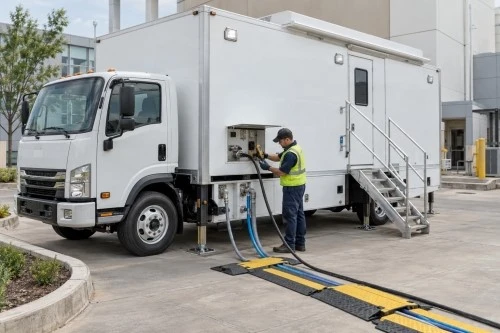
A deployment checklist typically covers site survey, parking orientation, levelling, stabilizers, steps or lifts, weather protection, external power, generator exhaust, water, drainage, gas source, communications and controlled access. Safe clearances must be maintained around exhausts, condensers, service panels and emergency exits.
After connections, staff perform pre-use checks. These may include power quality, backup operation, HVAC stabilization, pressure relationship, gas levels and alarms, water, lighting, equipment function, stock and emergency equipment. Clinical work should begin only after the unit meets the operator's release criteria.
The WHO Surgical Safety Checklist can support team communication around a procedure, but the vehicle also needs a separate technical readiness checklist. One verifies the surgical process; the other verifies the mobile facility.
Integrated System Chain
|
Input |
Vehicle system |
Clinical output |
Typical verification |
|
Outside air and return air |
HVAC, filters, controls and ductwork |
Controlled temperature and airflow relationship |
Commissioning measurements and alarm checks |
|
Shore power or fuel |
Switchgear, generator, UPS and circuits |
Reliable power at each approved device |
Load test, transfer test and electrical inspection |
|
Medical gas source |
Storage, regulation, piping and alarms |
Gas available at point of use |
Pressure/leak test and source-changeover test |
|
Fresh water |
Tank, pump, heater and fixtures |
Hand hygiene and cleaning support |
Flow, temperature, leak and drain test |
|
Clinical plan |
Layout, equipment and staff workflow |
Repeatable surgical pathway |
Simulation, checklist and team sign-off |
9. Turnaround Restores Readiness
After a case, used items and waste leave through the planned route, surfaces are processed, consumables are replenished and equipment is checked. Instruments move to the validated reprocessing pathway selected by the healthcare operator. The HVAC system may require a defined recovery period before the next procedure, depending on the approved protocol.
Before travel, utilities are disconnected, tanks and external components are secured, slide-outs retract, equipment locks are engaged and an inventory confirms that nothing remains loose. Maintenance observations from the deployment should be logged so faults do not follow the unit to the next site.
FAQ
Q: Does a mobile operating room work independently from a hospital?
A: It can carry many utilities, but clinical independence depends on the mission. Laboratory, sterilization, blood, recovery, pharmacy, referral and staffing support may still be external.
Q: Why is positive pressure discussed for operating rooms?
A: It can help direct air from the cleaner room toward adjacent spaces. Exact criteria and verification methods must follow the approved local design basis.
Q: What happens when external power fails?
A: The answer depends on the designed power architecture. Critical loads may transfer to a generator, UPS or battery source, while noncritical loads may stop.
Q: Can one vehicle perform every type of surgery?
A: No. Space, equipment, anaesthesia, recovery, sterile supply and referral capability place practical and regulatory limits on the procedure scope.
Conclusion
A mobile operating room works when transport engineering and clinical engineering are treated as one system. Airflow, power, gases, water, equipment and human movement are interdependent. Clear operating states, commissioned utilities and disciplined checklists turn a fitted vehicle into a repeatable clinical workspace.