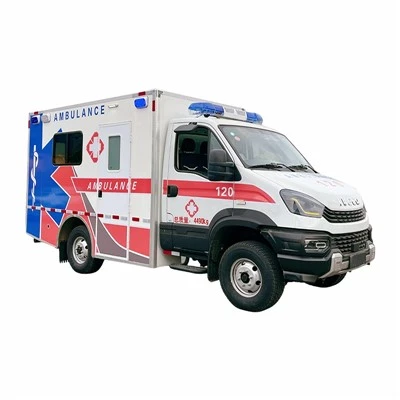


If you’ve ever waved at an ambulance speeding down the street—lights flashing, siren wailing—you might not think about what’s under its hood, but as a BLS ambulance supplier, I get asked this all the time: “What’s the fuel efficiency of a BLS ambulance?” It’s not a trivial question, either. BLS (Basic Life Support) units are the workhorses of emergency medical services, responding to 911 calls, transporting patients to appointments, and covering a huge chunk of every EMS provider’s budget. Higher fuel bills mean less money for life-saving supplies, training, and maintaining the rigs themselves, so getting the numbers right matters more than you’d think.
First, let’s nail down what a BLS ambulance is, because that changes how we calculate fuel efficiency. Unlike ALS (Advanced Life Support) units, which have extra med gear, specialized equipment, and often bigger engines, BLS ambulances are built for flexibility: they can carry a patient, a medic or two, and the basic tools you need—defibrillators, oxygen, bandages, all that stuff—without being overkill. Most of them are based on cargo vans, which makes sense: vans are easy to customize, maneuverable in tight city streets, and (relatively) lighter than purpose-built trucks. But even with that baseline, fuel efficiency varies a ton, depending on the make, model, age, how it’s used, and even where it’s driving.
Let’s break down the real numbers, not the generic “van fuel economy” you’d see for a regular work van. I see these rigs day in and day out, so I can tell you what actually happens in the real world, not the showroom floor. A lot of factors tank efficiency right off the bat: ambulances are rarely empty. Even a BLS unit has the patient cot, oxygen tanks, a full med cabinet, and maybe gurney supplies—add 500-1,000 lbs of extra weight that a regular van doesn’t carry. Then there’s the wear and tear of emergency driving: hard accelerations, quick stops, idling while waiting at a scene or stuck in traffic, and even the extra electrical load from lights, sirens, and the onboard battery charger for med gear. That stuff adds up fast.
Take our Toyota-based BLS models, for example. We’ve got the Toyota Hiace Patient Transport Ambulance Vehicle which is super popular in regions where compact, maneuverable vans are key. On average, when it’s used for routine transports (not lights and sirens the whole time), that Hiace gets around 18-22 miles per gallon (mpg) on the highway, and 12-16 mpg in the city. Now, that’s with the full BLS package—add lights and siren use, idling, and extra weight, and that city number can drop to 10-14 mpg. For a lot of EMS providers, who run these vans 24/7, that’s a noticeable difference. We also have the Toyota LHD First Aid Ambulance BLS Patient Transport Van, which is great for left-hand drive markets, and it’s pretty similar in efficiency—maybe a touch lower if you’re going for an extended-range model, but still solid for a van-based BLS unit.
Now, if diesel is more your speed, we’ve got Ford models too, which are a big hit with providers who do a lot of highway driving between hospitals. The Ford T8 Diesel Ambulance Euro 6 ICU Medical Vehicle—wait, hold on, even though it’s labeled for ICU, it’s definitely BLS-compatible, right? Yeah, we can spec it down to BLS levels for providers that don’t need the extra intensive care gear. That T8 diesel gets way better highway efficiency: around 22-26 mpg on the open road, and 14-18 mpg in the city. Diesel engines tend to be more fuel-efficient for longer hauls, so if your EMS service covers a large rural area where you’re driving 50+ miles between calls, that T8 is a game-changer. Then there’s the Ford Transit Patient Transport Ambulance, which is probably our best-selling BLS rig right now. The Transit, when converted to BLS specs, gets about 20-24 mpg highway and 13-17 mpg city—super reliable, easy to get parts for, and the fuel numbers are hard to beat for a mid-size BLS unit.
We also import Iveco models for European and some global markets, and the Iveco Diesel BLS Type I II Ambulance Medical Van is worth mentioning here. Iveco’s diesel engines are built for torque and long life, so even when you’re fully loaded with BLS gear, you’re looking at 19-23 mpg highway and 12-15 mpg city. It’s a little bulkier than the Toyota Hiace, so you lose a touch of city efficiency, but it’s a workhorse that holds up really well in rough conditions, so if you’re running calls in mountainous or rural areas, that’s a solid pick.
Wait, but let’s get one thing straight: those numbers aren’t set in stone. I’ve seen BLS ambulances hit 15 mpg highway if they’re well-maintained, driven smoothly, and only used for routine transports. I’ve also seen some that get as low as 8 mpg city, and that’s usually because of two big issues: bad driving habits (hard acceleration, constant idling with lights/sirens on) and poor maintenance. It’s wild how much a tune-up can change things—changing the air filter, getting the tires inflated to the right pressure, even replacing old spark plugs can add 2-3 mpg to a BLS ambulance. A lot of EMS providers skip that because they’re swamped, but it’s a small tweak that saves thousands a year in fuel.


Another big factor: idling. Ambulances idle a lot. When you’re waiting at a call scene, running lights and siren while you load a patient, or sitting in traffic on the way to the hospital, that’s fuel going up in smoke. A lot of providers don’t realize that idling for 10 minutes uses almost as much fuel as driving a mile. So if your BLS ambulance is idling for 2 hours a day, that’s 12 gallons of fuel wasted every day—almost $50 a day, at current prices. That adds up to over $18,000 a year just in idling. Some of our newer models come with idle reduction tech, which shuts the engine off after 5 minutes of idling and runs a small auxiliary battery to power lights and med gear. That small feature can boost fuel efficiency by 10-15% in city driving alone, and it’s a huge sell for providers watching their budgets.
What about electric? I get this question all the time too—are there electric BLS ambulances with better fuel efficiency? Right now, they’re pretty rare, and most of the ones I’ve tested have smaller batteries that don’t hold up for 12-hour EMS shifts, especially if you’re running lights, siren, and all the med gear. You might get 80-100 miles on a full charge, which is fine for small urban services, but if you’re covering 200 miles a day in a rural area, you’re stuck stopping to charge every few hours. That’s not ideal for emergency calls, so electric BLS is still a niche product for now, not a replacement for the diesel or gas models we offer.
As a supplier, my job isn’t just to sell ambulances—it’s to help EMS providers save money without cutting corners on safety. So when a client comes to me asking about BLS ambulance fuel efficiency, I don’t just give them a number off a spec sheet. I ask them: where are you operating? City, rural, or a mix? How many calls a day? How many miles do you drive each shift? Do you spend a lot of time idling? That’s how we pick the right model. If you’re a small urban EMS service that runs short, frequent calls, the Toyota Hiace or LHD model is perfect—compact, easy to park, solid efficiency. If you’re a large rural service with long hauls between hospitals, the Ford T8 or Iveco diesel is going to save you way more in fuel over time.
A lot of people think fuel efficiency for ambulances is just a minor detail, but for EMS providers, it’s a big deal. Every dollar saved on fuel is a dollar that can go to training new medics, buying new defibrillators, upgrading the patient cots, or even lower tax bills for the community. That’s why we spend so much time testing each of our BLS models, refining the conversions to be as light as possible without sacrificing safety or functionality, and equipping them with the little tech that boosts efficiency.
If you’re in the market for a BLS ambulance and want to talk through which model makes sense for your service, don’t hesitate to reach out. We can walk you through the real-world fuel numbers, compare models, and even help you figure out how to squeeze a few more mpg out of your current rig.
References:
- U.S. Department of Energy, Alternative Fuels Data Center: Light-Duty Vehicle Fuel Economy Trends, 2024
- National Association of EMS Physicians, Ambulance Fleet Efficiency Report, 2023
- Toyota Motor Corporation, Commercial Van Fuel Economy Specifications, 2024
- Ford Motor Company, Transit Ambulance Operational Efficiency Guide, 2024